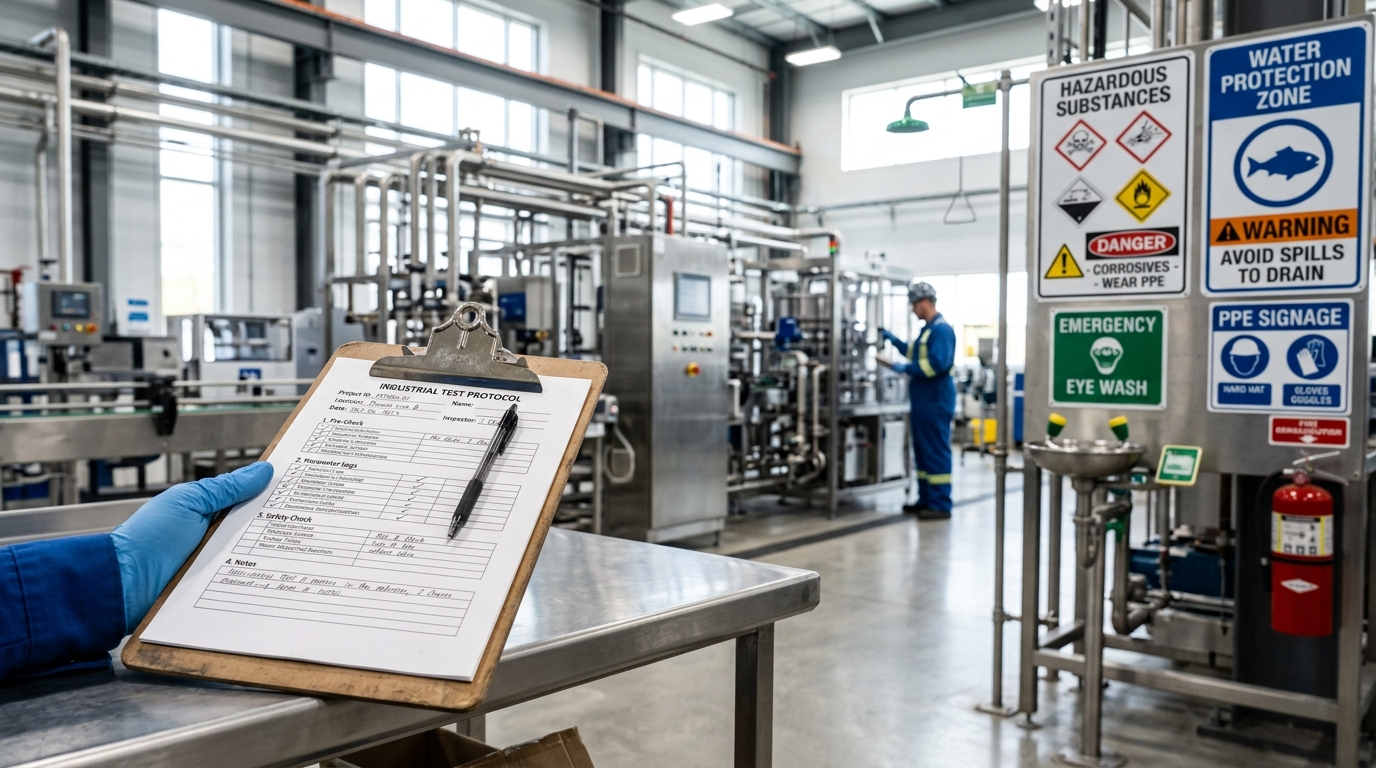
Hazardous-Substance Expertise: Chemical Trade, Asbestos (TRGS 519) and Separators
Learn how to appoint and manage competent persons for ChemVerbotsV, TRGS 519, and separator systems to avoid severe personal liability and 50,000 Euro fines.
Key Takeaways
- Companies trading hazardous substances must appoint a competent person under ChemVerbotsV Section 11 to supervise sales and keeping of logs.
- Asbestos Arbeiten under TRGS 519 mandate certified competent persons with certificates that must be renewed every 6 years.
- Operators of light-liquid separators must perform monthly self-monitoring and secure a general inspection by an expert every 5 years.
- Failure to comply with these officer roles exposes managing directors to personal liability and administrative fines of up to 50,000 Euros.
Introduction: The Corporate Mandate for Hazardous-Substance Experts in Germany
Operating safely in German industrial, retail, and manufacturing sectors requires compliance with a dense web of environmental and chemical safety laws. For executive teams, managing directors, and Health, Safety, and Environment (HSE) leads, ignoring these regulations carries significant corporate risk. Under German administrative and criminal law, companies must establish clear internal structures to manage dangerous substances. When dealing with specialized operations, German law goes beyond general safety protocols, requiring the formal appointment of competent individuals who possess certified expertise. Failing to appoint these experts can result in severe regulatory fines, operational shutdowns, and personal administrative liability for the company's executive officers.
Navigating Germany's Multi-Tiered Regulatory Architecture
To maintain a compliant corporate framework, international groups with German branches and mid-market German firms must navigate three distinct areas of hazardous substance regulation. These include the distribution of restricted chemicals under the German Chemicals Prohibition Ordinance (ChemVerbotsV), the safe handling of asbestos during maintenance under Technical Rules for Hazardous Substances 519 (TRGS 519), and the mandatory self-monitoring of light-liquid separators under DIN 1999-100 and DIN EN 858. Each area is subject to direct supervisory oversight. In the chemical trade, for instance, regulatory authorities have intensified checks on whether organizations have appointed a certified competent person to manage restricted substances and deliver annual safety instruction to sales staff[1]. For international groups operating in Germany, maintaining legal compliance across these areas is a top priority managed by a designated compliance officer.
- Chemical Trade Competency: Establishes a certified supervisor under Section 11 of the ChemVerbotsV to ensure compliance when placing restricted substances or mixtures on the German market.
- Asbestos Safety (TRGS 519): Mandates a certified competent individual to oversee all demolition, refurbishment, and maintenance work involving hazardous asbestos fibers.
- Separator Self-Monitoring: Requires trained operators to conduct monthly, bi-weekly, and general five-year technical audits of light-liquid separators to prevent ground and surface water contamination under DIN and EN guidelines.
Managing these specialized appointments requires meticulous documentation and proactive task tracking to remain audit-ready. To prevent compliance gaps and protect executives from liability, many organizations utilize the digital CIVAC Workspace to centralize task tracking and training schedules. Alternatively, firms can outsource these specialized functions by leveraging managed compliance solutions like CIVAC Externe Beauftragte to secure certified external officers. This article provides a highly practical, legally grounded blueprint detailing the precise statutes, legal duties, training requirements, and liability rules for each of these three crucial corporate roles.
The Competent Person for the Chemical Trade (ChemVerbotsV Section 11)
Companies that place restricted hazardous materials on the German market face stringent legal requirements under Section 11 of the Chemicals Prohibition Ordinance (Chemikalien-Verbotsverordnung, or ChemVerbotsV). Under this framework, any commercial entity selling or dispensing highly toxic, carcinogenic, mutagenic, or otherwise hazardous substances is legally mandated to obtain an official authority permit and designate a qualified competent person (sachkundige Person). This role acts as a critical interface between regulatory enforcement and daily trade operations, ensuring that restricted substances do not fall into the hands of unauthorized individuals or end-users without proper safety instruction[2]. While general handling is overseen by an internal or external Gefahrstoffbeauftragter, the chemical trade requires this specific expertise to operate legally.
Core Duties and the Dispensing Ledger
The daily responsibilities of the competent person are highly operational and strictly regulated. When dispensing controlled chemicals, the competent person must perform a series of compliance checks before any product leaves the premises. They must verify the identity of the customer, confirm their legal right to purchase and use the hazardous substance, and secure a signed end-use declaration (Endverbleibserklärung) to rule out misuse. Furthermore, the transaction must be logged in a physical or digital dispensing ledger (Abgabebuch). This ledger serves as a permanent, audit-proof record of every sale and must contain detailed information on the substance type, volume, recipient, and the specific hazard warnings provided during the sale.
Qualifying and Maintaining the Sachkunde
Acquiring the necessary competence (Sachkunde) requires passing a specialized exam administered by a state authority or an officially recognized institution. Alternatively, certain professional qualifications are recognized as equivalent, such as being a registered pharmacist, pharmacy engineer, or a certified pest control operator. However, this qualification is not permanent. The law demands a strict refresher training cycle to keep the expertise active. If the original exam or previous training occurred more than six years ago, the competent person must complete a full-day refresher training course. Alternatively, they can maintain compliance by attending a half-day refresher course every three years to stay updated on the latest chemical regulations and hazard classifications.
- Legal Basis: Section 11 of the German Chemicals Prohibition Ordinance (ChemVerbotsV) governs the qualification and duties of the competent person.
- Authority Permit: Required for any company commercializing or distributing restricted chemicals listed in Annex 2.
- Customer Verification: Mandatory identification, verification of expertise, and collection of a signed end-use declaration.
- Dispensing Ledger: Detailed logging of every transaction, which must be stored securely for regulatory audits.
- Refresher Cycle: Mandatory training every three years (half-day) or six years (full-day) to prevent the expiration of the legal competence.
Failure to designate a competent person or neglecting the dispensing ledger constitutes a severe violation of the German Chemicals Act (Chemikaliengesetz). These compliance gaps expose managing directors and HSE leads to significant administrative fines of up to 50,000 euros, and in cases of intent or criminal negligence, can lead to criminal prosecution and the revocation of the company's trading permit. Utilizing structured digital workflows is the most reliable way to monitor these refresher training deadlines and keep logs audit-ready, bridging the gap between operational trade and corporate compliance.
The Asbestos Competent Person for ASI Works (TRGS 519)
The legal foundation in Germany for dealing with asbestos is exceptionally strict. Under the Ordinance on Hazardous Substances (Gefahrstoffverordnung - GefStoffV) in conjunction with the Technical Rules for Hazardous Substances 519 (Technische Regeln für Gefahrstoffe - TRGS 519), any activity involving demolition, refurbishment, or maintenance (ASI works) on asbestos-containing materials requires a designated competent person (Sachkundiger). This individual is legally responsible for ensuring that asbestos fibers are not released into the air and that workers are fully protected[3]. Given the severe health risks associated with asbestos exposure, appointing this competent officer is not just an administrative best practice, but a mandatory legal obligation for any German company or international group executing building works on structures built before the asbestos ban of 1993. This oversight is often coordinated with an occupational safety specialist to guarantee comprehensive site compliance.
Core Duties and Responsibilities under TRGS 519
The competent person for asbestos bears immense operational and legal responsibility on-site. Before any demolition or refurbishment begins, they must conduct a comprehensive hazard assessment (Gefährdungsbeurteilung) to identify the type of asbestos (friable or non-friable) and determine the exact protective measures required. Furthermore, they are responsible for filing the mandatory official notification (Anzeige) with the local occupational safety authority (Gewerbeaufsichtsamt) and the relevant social accident insurance institution (Berufsgenossenschaft) at least 14 days prior to commencing the works[3]. During the project, they must continuously supervise the installation of containment zones, negative pressure units, and decontamination facilities, while ensuring that all personnel are wearing appropriate personal protective equipment.
Qualification and the 6-Year Validity Rule
To act as a competent person, an individual must obtain a certificate of competence (Sachkundenachweis) by completing an officially recognized training course and passing a state-monitored examination. The specific training pathway is divided into separate annexes of TRGS 519: Anlage 3 covers comprehensive expertise for all asbestos ASI works (including high-exposure projects), while Anlage 4 is designed for restricted, low-exposure, or small-scale maintenance tasks. Crucially, these certificates do not remain valid indefinitely. Under German law, the Sachkundenachweis has a strict six-year validity period (6-jährige Geltungsdauer). To extend the certificate for another six years, the holder must attend a recognized refresher training course (Fortbildungslehrgang) before the original certificate expires; otherwise, the competence is lost, and the individual must retake the entire initial examination.
Liability, Fines, and Criminal Consequences
Non-compliance with TRGS 519 carries some of the most severe legal risks in German occupational safety law. Failing to properly assess asbestos hazards, neglecting the official notification duties, or executing works without a certified competent person constitutes an administrative offense (Ordnungswidrigkeit) that can trigger corporate fines of up to 50,000 euros under GefStoffV. However, because asbestos is a known carcinogen, improper handling rapidly crosses the threshold into criminal prosecution. Under the German Criminal Code (Strafgesetzbuch - StGB), unauthorized handling of hazardous waste (StGB § 326) and causing harmful air pollution (StGB § 325) are criminal acts punishable by up to five years in prison or substantial criminal fines, even in cases of negligence[4]. Managing directors, HSE leads, and internal compliance officers can face personal criminal liability and charges of negligent bodily harm (StGB § 229) if workers or the public are exposed to asbestos dust.
At a Glance: Key Requirements of TRGS 519
- Legal Basis: GefStoffV and Technical Rule TRGS 519 for demolition, refurbishment, and maintenance (ASI) works.
- Appointment Trigger: Mandatory for any company executing works on asbestos-containing materials on construction sites.
- Key Duties: Hazard assessments, 14-day official pre-notices, supervising protective measures, and site safety management.
- Required Qualification: Official certificate of competence according to TRGS 519 Anlage 3 or Anlage 4.
- Validity: Strict six-year period; must be extended via a recognized refresher course before expiration.
- Liability Risks: Regulatory fines up to 50,000 euros and criminal prosecution under StGB with up to five years in prison.
The Separator Competent Person for Light-Liquid Systems (DIN 1999-100 and DIN EN 858)
Industrial and commercial operations discharging wastewater containing mineral oils, gasoline, or other light liquids must operate specialized light-liquid separator systems. To prevent environmental contamination and comply with German water law, operators are required to designate a qualified competent person (Sachkundiger) for these separator installations. This specialist ensures that the system is properly monitored, maintained, and inspected in accordance with DIN 1999-100 and DIN EN 858 standards.
- Legal Basis: Section 60 of the German Water Resources Act (WHG) in conjunction with standards DIN EN 858 and DIN 1999-100.
- Mandatory Appointment: Required for any company operating light-liquid separators, such as petrol stations, car washes, and automotive workshops.
- Routine Duties: Monthly self-monitoring checks, semi-annual system maintenance, and maintaining the operating logbook.
- Five-Year Inspection: Mandatory general inspection (Generalinspektion) performed by an external independent expert (Fachkundiger).
- Liability Exposure: Violations are classified as administrative offenses carrying fines of up to 50,000 EUR, alongside potential criminal penalties for environmental damage.
Legal Basis and Appointment Obligations
The legal foundation for operating light-liquid separators is anchored in Section 60 of the German Water Resources Act (Wasserhaushaltsgesetz - WHG), which dictates that wastewater facilities must be built and operated in compliance with the recognized rules of technology. For light-liquid systems, these rules are defined in the European standard DIN EN 858 and the supplementary German standard DIN 1999-100[5]. Any business that generates oily wastewater, such as transport companies, vehicle repair shops, or industrial cleaning plants, has a strict statutory obligation to appoint a competent person to manage these systems. This role can be assigned to an internally trained employee or outsourced to an external specialist.
| Interval | Required Compliance Task | Responsible Person |
|---|---|---|
| Monthly | Self-monitoring checks (sludge volume, oil layer thickness, automatic shut-off valve, and visual outlet inspection) | Competent Person (Sachkundiger) |
| Semi-Annually | Technical maintenance (coalescing filter check, cleaning or replacement, and full system functional testing) | Competent Person (Sachkundiger) |
| Every 5 Years | General inspection (Generalinspektion) including leak-tightness testing of all components and structural integrity check | Independent Expert (Fachkundiger) |
Duties and Documentation Requirements
The competent person is responsible for the day-to-day operational safety of the separator system. Their primary tasks involve performing monthly self-monitoring routines to measure the volume of accumulated sludge and the thickness of the separated oil layer. They also verify that the automatic closing device functions and inspect the system's warning sensors[6]. Every six months, the competent person performs advanced maintenance, which includes checking the coalescing filter insert and ensuring optimal flow rates. To maintain regulatory compliance, all monthly checkups, maintenance work, sludge removals, and inspections must be recorded chronologically in an operating logbook (Betriebstagebuch). This logbook must be kept on-site at all times and made available to municipal wastewater authorities during random audits.
Qualification, Liability, and Financial Fines
To legally perform these tasks, the assigned individual must possess a certificate of competence (Sachkundenachweis) acquired through a certified training course under DIN 1999-100[7]. This training ensures they understand the mechanical functions, legal guidelines, and proper measurement techniques. For HSE leads and compliance officers, neglecting these duties represents a significant liability risk. Under Section 103 of the WHG, failing to maintain, inspect, or properly operate a separator is an administrative offense punishable by fines of up to 50,000 EUR. If hazardous substances leak into the soil or groundwater, managing directors can face criminal prosecution under Section 324 of the German Criminal Code (StGB) for water pollution, which carries penalties of up to five years of imprisonment. Evaluating the internal costs of training and managing these tasks against external outsourcing models is a vital step for companies reviewing their overall environmental officer costs.
Strategic Compliance Management: How CIVAC Simplifies Specialised Officer Appointments
Managing multiple hazardous-substance roles internally can easily overwhelm corporate resources and expose management to significant liabilities. For executive directors and Health, Safety, and Environment (HSE) leads, coordinating the unique demands of chemical trade compliance, asbestos refurbishment safety, and light-liquid separator maintenance requires continuous educational tracking, secure document control, and liability mitigation. To ease this burden, companies can implement digital compliance management systems and outsource key administrative responsibilities[8].
Digital and Managed Solutions for Modern Enterprises
Whether your organization chooses to cultivate these specialized expertise roles internally or mandate them externally, maintaining an audit-proof trail is non-negotiable. This is where CIVAC provides a dual-path approach to compliance. With the CIVAC Workspace software platform, internal compliance teams gain a centralized hub for managing tasks, scheduling mandatory training, and storing audit-safe documentation. For companies looking to transfer operational risks and reduce internal training overhead, the CIVAC Externe Beauftragte service offers direct appointment of certified, legally compliant external officers who manage these hazardous-substance duties.
| Compliance Dimension | CIVAC Workspace (Internal) | CIVAC Externe Beauftragte (External) |
|---|---|---|
| Operational Overhead | Managed internally with automated task flows | Fully outsourced to certified external experts |
| Liability & Risk | Remains with the internal appointees and executives | Transferred legally to the external officer |
| Documentation | Centralized, audit-proof storage of certificates | Handled completely by CIVAC experts on your behalf |
Securing Hazardous Substance Compliance
By integrating specialized safety roles under a single management system, enterprises can systematically close compliance gaps. This unified oversight is particularly vital for interconnected responsibilities, such as having a certified Gefahrstoffbeauftragter coordinate with local chemical trade and separator specialists to ensure seamless, legally compliant facility operations. With over 905 ready-to-use templates and automated compliance tracking, businesses can actively streamline their audit preparation and face official state inspections without administrative risk.
Frequently Asked Questions
Who needs a competent person under Section 11 of the Chemicals Prohibition Ordinance (ChemVerbotsV)?
Any enterprise that places certain hazardous substances or mixtures listed in Annex 2 of the ChemVerbotsV on the market, or hands them over to third parties, must obtain a formal permit. To secure this permit, they must appoint a competent person (Sachkundige Person) who has proven their expertise through a state-approved examination. This individual ensures that restricted chemicals are only sold to authorized buyers and that a proper dispensing ledger is maintained.
How long is the asbestos certificate of competence under TRGS 519 valid?
The asbestos certificate of competence (Sachkundenachweis) has a limited validity of 6 years in Germany. To extend the validity of this certificate for another 6 years, the holder must successfully complete a state-approved 1-day refresher course under Annex 5 of TRGS 519 before the existing certificate expires. If it expires, the full multi-day training and examination must be retaken.
What is the difference between a competent person and a specialized expert for separators?
For light-liquid separators under DIN 1999-100 and DIN EN 858, a competent person (Sachkundiger) is appointed by the operator to perform regular self-monitoring (monthly checks of oil/sludge layers and visual checks) and semi-annual maintenance. In contrast, a specialized expert (Fachkundiger) is required to conduct a comprehensive general inspection (Generalinspektion) of the separator system every 5 years.
What are the legal consequences of performing asbestos work without a TRGS 519 expert?
Performing demolition, refurbishment, or maintenance (ASI) work on asbestos-containing materials without a certified competent person is a serious violation. Under the German Criminal Code (StGB) and the Ordinance on Hazardous Substances (GefStoffV), this constitutes a criminal offense punishable by fines or up to 5 years of imprisonment, as asbestos exposure is a major health hazard.
Can a German company outsource hazardous-substance officer roles to external providers?
Yes, companies can appoint external officers to fulfill these specialized compliance roles. Using specialized services like CIVAC Externe Beauftragte allows enterprises to legally delegate these responsibilities to certified external experts, which reduces internal training efforts, mitigates liability risks, and ensures immediate, audit-ready compliance.
Sounds like a lot of work?
Officer duties, deadlines, paperwork — that's exactly what we take off your hands. Say hello and we'll show you how.
The officer role behind this article
Sources
- umco.de
- gesetze-im-internet.de
- baua.de
- blog.gsa-messgeraete.de
- dekra-akademie.de
- remondis-industrie-service.de
- hwk-duesseldorf.de
- csb-compliance.com
- Audit-Vorbereitung mit CIVAC
- Leistungen von CIVAC
- Umweltbeauftragter Kosten: Was Bestellung, Pflichten und externe Beauftragung wirklich kos
- Die CIVAC Compliance-Plattform
- Compliance-Beauftragter: Pflichten, Bestellung, AI Act 2026
- Fachkraft für Arbeitssicherheit (SiFa)
- Externer Gefahrstoffbeauftragter
Turn this into a mandate.
Let us carry the operational weight. External officer, templates and documentation in one workspace. No obligation.

Sections 6, 17, 45 ElektroG: registration before placing on the market, take-back from 400 square metres, fines up to EUR 100,000