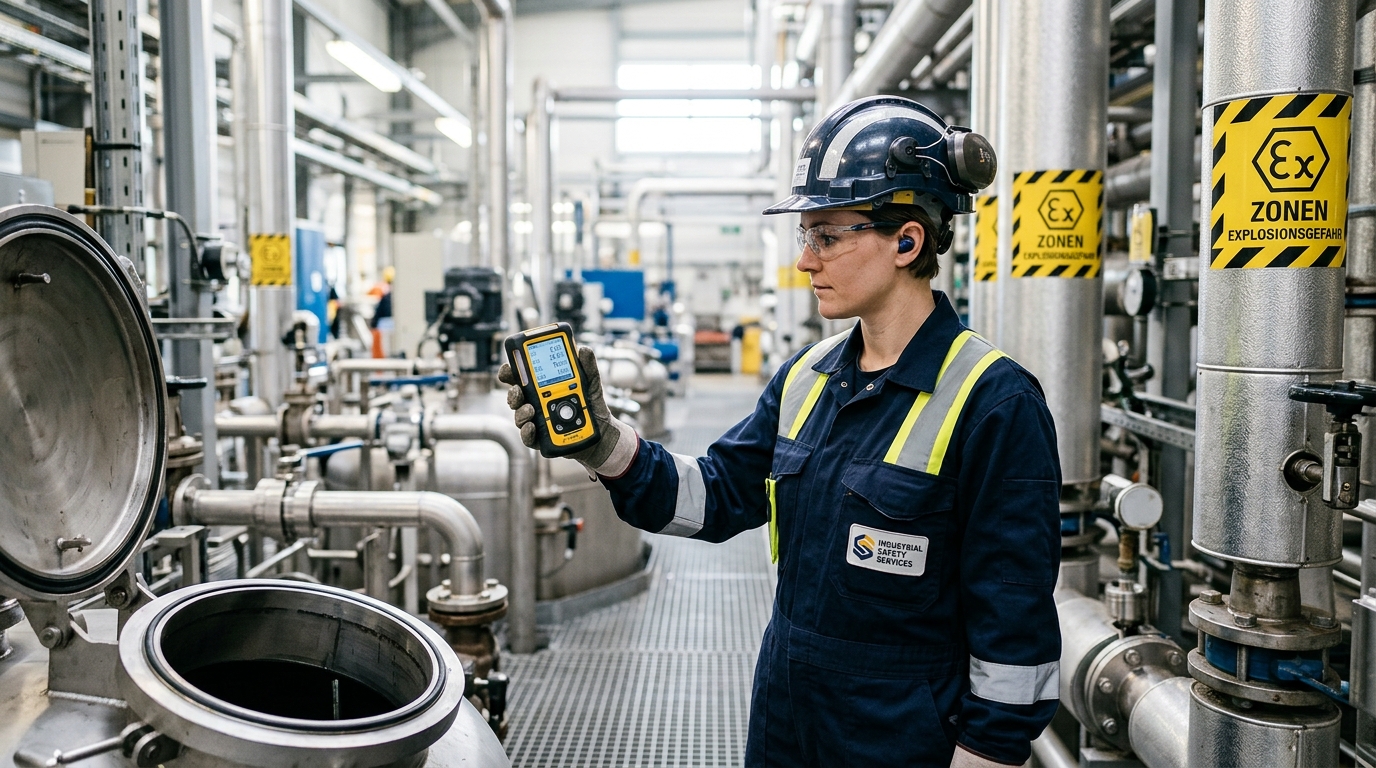
Explosion Protection and Gas Measurement: Officers and Competent Persons
A comprehensive guide to German occupational safety rules for Explosion Protection Officers and Gas Freeing Competent Persons under GefStoffV and DGUV Rules.
Key Takeaways
- German law mandates competent safety officers for explosion protection and clearance measurements to prevent catastrophic industrial accidents.
- Explosion Protection Officers must maintain a formal explosion protection document in compliance with GefStoffV and TRGS 720-722.
- Performing clearance measurements (Freimessen) in confined spaces requires an expert certified under DGUV Principle 313-002 guidelines.
- Non-compliance with corporate safety officer mandates can trigger severe administrative fines of up to 25,000 EUR or criminal charges.
- The compliance platform CIVAC Workspace and CIVAC Externe Beauftragte services provide audit-proof tracking and secure external appointments.
Introduction: The Dual Pillars of German Industrial Safety
Industrial operations involving volatile substances require strict adherence to German occupational health and safety regulations to mitigate the risk of catastrophic incidents. In environments where flammable gases, vapors, or combustible dusts are present, German law mandates systematic preventive frameworks. Two specialized functions serve as the primary defensive pillars in these high-risk settings: the Explosion Protection Officer (Explosionsschutzbeauftragter or competent person under GefStoffV) and the Competent Person for Gas Freeing and Workplace Hazardous-Substance Measurement. Together, these roles ensure that explosive atmospheres are identified, managed, and neutralized before work begins in enclosed spaces, vessels, or hazardous zones.
The Intersection of Prevention and Atmospheric Control
While the explosion protection focus area encompasses structural and electrical safety standards to prevent ignition, gas freeing focuses on real-time atmospheric measurement and clearance. The Explosion Protection Officer is responsible for developing the mandatory explosion protection document (Explosionsschutzdokument) and classifying risk areas into zones according to the German Hazardous Substances Ordinance (Gefahrstoffverordnung - GefStoffV) and TRGS 720-722, which aligns with DGUV Rule 113-001[1]. Conversely, the competent person for gas freeing ensures that confined spaces, silos, or tanks are safe to enter by carrying out precise measurements according to DGUV Rule 113-004[2]. This operational synergy is essential for protecting personnel from toxic exposure and explosive flashpoints.
- Explosion Protection Officer: Mandated under GefStoffV and TRGS 720-722 to define protective measures, classify explosive zones, and maintain the formal explosion protection document.
- Gas Freeing Competent Person: Appointed under DGUV Rule 113-004 and TRGS 402 to measure gas concentrations, vent confined spaces, and officially release vessels for safe human entry.
- Compliance Obligation: Managing directors and HSE leads face personal liability and severe corporate fines under German occupational safety laws if these roles are not properly staffed.
- Integrated Safety: Successful operations require absolute synchronization between permanent structural safeguards and active, measurement-based workplace clearances.
For managing directors, compliance officers, and HSE leads, securing these operational competencies is not merely an operational recommendation but a strict legal mandate. Failing to properly appoint qualified individuals can trigger significant liability, administrative fines, and even criminal prosecution in the event of an industrial accident. Businesses operating in Germany can utilize CIVAC Workspace to seamlessly organize these appointments, track mandatory qualifications, and document safety checklists in an audit-proof manner. Integrating these technical roles into a unified compliance workflow ensures that physical safety measures match the stringent requirements of German industrial standards.
Explosion Protection Officer (GefStoffV): Legal Foundations and Mandates
Operating industrial or commercial facilities where flammable gases, vapors, mists, or dusts are handled involves severe safety risks and strict regulatory oversight. In Germany, managing directors and health, safety, and environment (HSE) leads face rigorous legal demands to prevent catastrophic incidents. The core legal framework governing these environments is the German Ordinance on Hazardous Substances (Gefahrstoffverordnung, or GefStoffV), which dictates precise preventative measures and mandates the appointment of competent personnel to oversee explosion risks[3]. Failing to comply with these rules not only poses acute physical dangers but also exposes corporate leadership to significant personal liability and severe fines.
The Statutory Core: GefStoffV and Supporting Technical Rules
The legal mandate for structured explosion protection stems directly from Section 6 of the GefStoffV. Under Section 6, Paragraph 9 of the Ordinance (§ 6 Abs. 9 GefStoffV), employers are legally obligated to compile and continuously update a comprehensive Explosion Protection Document (Explosionsschutzdokument)[3]. This document serves as the cornerstone of the company's explosion safety concept, and its preparation must be guided by technical expertise. This expertise is codified in the Technical Rules for Hazardous Substances (Technische Regeln für Gefahrstoffe), specifically TRGS 720, TRGS 721, and TRGS 722, which outline the general principles, hazard assessments, and concrete measures required to restrict or avoid hazardous explosive atmospheres[4]. These rules are further complemented by DGUV Rule 113-001 (formerly known as the EX-RL guidelines), which provides extensive practical examples and guidance for safe industrial operations.
Because compiling and maintaining an Explosion Protection Document requires deep specialized knowledge, most organizations cannot handle this task through generic occupational safety roles alone. Managing directors often appoint a dedicated Explosion Protection Officer or coordinate closely with a specialized hazardous substances officer to ensure all technical rules are implemented seamlessly. This expert, acting as a competent person (zur Prüfung befähigte Person), bridges the gap between theoretical statutory mandates and day-to-day operational safety on the shop floor.
| Core Requirement | Legal / Regulatory Reference | Key Operational Objective |
|---|---|---|
| Explosion Protection Document | § 6 Abs. 9 GefStoffV | Documenting the complete hazard assessment, risk evaluation, and technical safety concept for the facility. |
| Zone Classification | TRGS 720 - 722 / DGUV Rule 113-001 | Dividing hazardous areas into standard zones (0, 1, 2 for gases; 20, 21, 22 for dusts) based on frequency and duration of explosive atmospheres. |
| System Inspections | TRBS 1201 Part 1 / § 15 GefStoffV | Ensuring that all technical protective installations are inspected by certified competent persons before initial commissioning and at regular intervals. |
Duties, Qualifications, and Liability of the Explosion Protection Competent Person
In Germany, industrial facilities and companies operating in environments with flammable gases, vapors, or dusts are subject to strict regulatory regimes. Under the Hazardous Substances Ordinance (Gefahrstoffverordnung - GefStoffV) [5]and the Industrial Safety and Health Ordinance (Betriebssicherheitsverordnung - BetrSichV)[6], employers must guarantee rigorous explosion protection. Any workplace where dangerous explosive atmospheres can form requires an explosion protection document (Explosionsschutzdokument). Developing this document and executing the required technical safety checks demands the appointment of an explosion protection competent person (zur Prüfung befähigte Person) as specified by TRBS 1203 (Technical Rules for Operational Safety). While an occupational safety specialist advises on broad industrial risks, specialized technical areas like explosive safety require these dedicated experts.
The competent person holds a pivotal role in operational safety. Their primary responsibility is to conduct in-depth risk assessments, define safety zones (Zones 0, 1, and 2 for gases; Zones 20, 21, and 22 for dusts), and outline technical, organizational, and structural protective measures. In companies where bulk chemicals or volatile materials are stored, these duties often overlap with those of a designated Gefahrstoffbeauftragter (hazardous substances officer) to establish a comprehensive compliance workflow. The competent person is tasked with ensuring that all equipment in hazardous areas complies with ATEX directives and that ignition hazards are systematically eliminated.
- Developing and updating the official explosion protection document (Explosionsschutzdokument) according to paragraph 6 of the GefStoffV.
- Dividing work areas into standardized hazardous zones based on the probability and duration of explosive atmospheres.
- Performing safety inspections of technical systems and protective equipment prior to commissioning and after significant changes.
- Formulating specialized operating instructions and training workers on specific behavioral rules in explosive areas.
- Verifying the correct installation, operational safety, and maintenance of all ex-proof components.
Technical Expertise and Qualifications under TRBS 1203
Acting as a competent person for explosion protection is not merely an honorary designation; it requires proven, high-level expertise (Fachkunde) under German technical standards. According to TRBS 1203, candidates must possess a relevant technical degree or comparable vocational training, coupled with multiple years of hands-on experience in the field of explosion safety. Crucially, they must maintain up-to-date knowledge through regular technical training. The employer is legally obligated to verify and document these qualifications, as appointing an underqualified individual constitutes a major organizational failure.
Severe Liability Risks and Regulatory Fines
Failing to appoint a competent person or failing to produce a valid explosion protection document exposes corporate leadership to significant risks. Under paragraph 25 of the Occupational Safety and Health Act (Arbeitsschutzgesetz - ArbSchG) and paragraph 22 of the BetrSichV, non-compliance is classified as an administrative offense. Managing directors, compliance officers, and HSE leads can face personal regulatory fines of up to 25,000 EUR per safety violation. More critically, if a lack of proper safety documentation or qualified supervision leads to an actual explosion resulting in personal injury or property damage, management can face criminal prosecution for negligent bodily harm or endangerment under the German Criminal Code (Strafgesetzbuch - StGB).
| Legal Regulation | Core Requirement | Maximum Penalty for Violation |
|---|---|---|
| GefStoffV Paragraph 6 | Creation and updating of the Explosion Protection Document | Up to 25,000 EUR fine or criminal charges in case of accident |
| BetrSichV Paragraphs 15 and 16 | Regular technical inspections of equipment by a competent person | Up to 25,000 EUR regulatory fine for missed or deficient testing |
| ArbSchG Paragraph 25 | Overall duty of care, risk assessments, and proper safety appointments | Up to 25,000 EUR fine, plus direct personal civil and criminal liability |
Competent Person for Gas Freeing (DGUV Rule 113-004): Legal Bases and Mandates
Entering confined spaces, silos, or vessels in industrial environments represents one of the most hazardous tasks in workplace safety. Toxic gases, explosive atmospheres, or severe oxygen deficiency can quickly lead to fatal accidents. To prevent these outcomes, German occupational health and safety regulations mandate a process known as clearance measurement or gas freeing (Freimessen) before any employee can enter these high-risk environments. Under German law, the employer is legally responsible for ensuring that these clearance measurements are conducted reliably. This task cannot be assigned casually; it requires the formal, written appointment of a qualified competent person (Fachkundiger zum Freimessen) who has been rigorously trained in gas detection and hazardous substance evaluation[7].
The German Statutory Framework: GefStoffV, TRGS 402, and DGUV Regel 113-004
The requirement to appoint a competent person for gas freeing rests on a robust framework of statutory laws and German Social Accident Insurance (DGUV) regulations. The Hazardous Substances Ordinance (Gefahrstoffverordnung, or GefStoffV) acts as the primary legal driver, specifically through Section 6 regarding risk assessments (Gefährdungsbeurteilung) and Section 11, which outlines specific protective measures for hazardous operations. While Technical Rule TRGS 402 governs the general identification and assessment of inhalative exposure hazards at the workplace, DGUV Regel 113-004 focuses specifically on safe operations in vessels, silos, and confined spaces. To properly manage these intersecting regulations and ensure that all hazard assessments align with statutory demands, many organizations rely on a designated Gefahrstoffbeauftragter to oversee broader chemical safety compliance.
- Gefahrstoffverordnung (GefStoffV): Mandates a comprehensive risk assessment (Gefährdungsbeurteilung) under Section 6 and establishes general duties to measure hazardous concentrations.
- TRGS 402: Establishes the technical standard for determining and evaluating airborne hazardous substances, providing the methodological background for gas measurement procedures.
- DGUV Regel 113-004: Dictates that entering confined spaces is prohibited until a formal clearance measurement is executed by a qualified expert.
- DGUV Grundsatz 313-002: Outlines the criteria for selecting, training, and formally appointing the competent person for gas freeing in writing.
When is a Written Appointment Legally Mandatory?
An employer must formally designate a competent person for gas freeing whenever the risk assessment indicates a potential danger from toxic vapors, combustible gases, or oxygen imbalances. Under DGUV Grundsatz 313-002, this appointment cannot be verbal; it must be executed in writing and explicitly outline the individual's specific scope of authority and designated work areas. Managing these appointments alongside ongoing qualification tracking can become complex, especially for international groups operating in Germany. Utilizing a dedicated digital compliance platform like the CIVAC Workspace ensures that these written appointments are documented in an audit-proof manner, keeping your operational compliance fully transparent and legally secure.
Clearance Measurement Duties, Qualifications, and Liability Exposure
The process of clearance measurement (known in German as Freimessen) represents one of the most critical safety barriers when working in vessels, silos, and confined spaces. According to the German Ordinance on Hazardous Substances (Gefahrstoffverordnung - GefStoffV) and Technical Rules for Hazardous Substances (such as TRGS 402 and TRGS 507), employers are legally obligated to evaluate inhalative hazards before permitting employees to enter confined areas. The designated competent person for gas freeing (Fachkundiger zum Freimessen) acts as the operational safeguard. This specialist executes precise measurements to detect toxic gases, flammable vapors, and oxygen anomalies, ensuring that the work environment is completely safe before issuing an entry permit.
Operational Duties of the Competent Person
In practice, the operational routine of a competent person extends far beyond simply reading numbers on a screen. Every clearance measurement requires a systematic, multi-step process that must be meticulously documented. This is especially true when collaborating with an occupational safety specialist or an appointed hazardous substance officer to align the measurement strategy with the overall corporate risk assessment.
- Pre-use testing and calibration: Performing regular bump tests, fresh air calibration, and sensory checks on portable gas detectors and testing tubes before any operational use.
- Tailored measurement strategies: Determining the ideal measuring locations, depth profile, and measurement duration based on the physical properties of the suspected hazardous substances.
- Logical measurement sequence: Always measuring oxygen concentrations first, followed by flammable or explosive gases, and finally toxic gases and vapors to prevent chemical cross-sensitivity errors.
- Continuous monitoring: Setting up stationary gas warning systems for ongoing surveillance of the workplace during work, especially when conditions may fluctuate.
- Formal clearance documentation: Recording all measured values, device details, and environmental parameters on a standardized clearance certificate (Freigabeschein) to create an audit-proof paper trail.
Qualifications and Training Curriculum under DGUV Principle 313-002
To be legally appointed as a competent person for clearance measurements, candidates must possess verifiable expert knowledge. The German Social Accident Insurance (DGUV) defines the strict qualification pathway under DGUV Principle 313-002[8]. This formal curriculum comprises at least 14 teaching units of 45 minutes each, typically structured into a two-day initial training course followed by an examination. Importantly, generic external certificates must always be supplemented by company-specific instruction detailing the exact gas warning devices and hazards present in the local workplace.
| Training Module | Recommended Duration | Key Curriculum Content |
|---|---|---|
| Legal Foundations | 2 Teaching Units | Review of ArbSchG, GefStoffV, TRGS 402, TRGS 507, and DGUV Rules 113-001 and 113-004. |
| Hazardous Substances | 4 Teaching Units | Chemical and physical properties, occupational exposure limit values (AGW), and explosive limits. |
| Gas Measurement Tech | 3 Teaching Units | Operating principles of electrochemical, infrared, or photoionization detectors (PID) and tube systems. |
| Measurement Strategy | 2 Teaching Units | Selecting appropriate measurement locations, durations, and handling complex tank geometries. |
| Practical Application | 2 Teaching Units | Hands-on device function tests, calibration procedures, and mock-clearance scenarios. |
| Examination & Verification | 1 Teaching Unit | A compulsory theoretical exam, often a multiple-choice paper, which must be documented and archived. |
Refresher Training and Liability Exposure
Acquiring the initial certificate is not a lifetime license. Technical developments and shifting regulatory standards mean that competent persons must regularly refresh their knowledge. Under DGUV guidelines, regular refresher training courses, typically designed as a one-day program, are necessary to maintain valid qualification. Failure to ensure continuous education or executing a faulty measurement carries extreme legal liability. In the event of a severe industrial accident, both the managing directors and the operational competent person face criminal investigation for negligent bodily harm (Section 229 StGB) or negligent homicide (Section 222 StGB). Regulatory fines for non-compliance with GefStoffV or DGUV Rule 113-004 can reach up to 10,000 EUR for individual violations, highlighting the absolute necessity of maintaining a robust, audit-proof record of all clearance procedures.
Leveraging CIVAC: Audit-Proof Digital Management and Officer-as-a-Service
Meeting the strict legal mandates of German safety regulations like the Ordinance on Hazardous Substances (Gefahrstoffverordnung or GefStoffV) and the German Social Accident Insurance (DGUV) requires rigorous organization. For mid-market companies and international groups, managing these specialized corporate officer roles can quickly become a compliance bottleneck. This is where CIVAC provides an integrated path forward, combining digital efficiency with professional expertise to keep your operations secure and compliant.
Digital Efficiency with CIVAC Workspace
For companies choosing to appoint internal team members as explosion protection officers or competent persons for gas freeing, the compliance platform known as CIVAC Workspace provides an all-in-one software solution. The platform automates safety task tracking, schedules mandatory recurrent training, and secures your documentation against liability risks. From managing the update cycles of your explosion protection document to logging measurements under Technical Rules for Hazardous Substances (TRGS 402), every action is recorded in a tamper-proof digital log, ensuring seamless audit preparation for external inspectors.
Risk Mitigation with CIVAC Externe Beauftragte
When internal resources are limited, or where the specialized nature of explosion safety and hazardous workplace measurements demands external expertise, CIVAC Externe Beauftragte offers a legally robust alternative. By legally appointing a certified external expert through this managed service, your company transfers operational compliance duties to qualified professionals. This approach significantly reduces the personal liability of managing directors and HSE leads, while guaranteeing that complex requirements, such as those detailed in ISSA guidelines and DGUV Rule 113-004, are met by highly trained specialists[9][2]. This structured support also integrates smoothly with broader company initiatives in hazardous substance management to maintain a cohesive workplace safety ecosystem.
Comparing Your Deployment Options
| Compliance Metric | Internal Management via CIVAC Workspace | External Appointment via CIVAC Externe Beauftragte |
|---|---|---|
| Primary Focus | Software-assisted coordination of internal company safety officers | Fully outsourced, legally appointed external safety specialists |
| Operational Burden | Low to moderate, with automated scheduling and task tracking | Minimal, as external experts handle operational workflows directly |
| Liability Management | Internal liability remains with the company, supported by audit-proof digital logs | Operational compliance liability is delegated to the external appointee |
| Best For | Organizations with qualified in-house staff seeking digital structure | Companies needing immediate, certified expertise without internal hiring |
Frequently Asked Questions
Is an explosion protection document legally mandatory for German businesses?
Yes. Under Section 6 of the Ordinance on Hazardous Substances (GefStoffV), employers must prepare and maintain a formal explosion protection document if hazardous explosive atmospheres can form. This document must be regularly updated by a qualified competent person to reflect changes in technical equipment or work procedures.
What qualifications must an Explosion Protection Officer possess?
An Explosion Protection Officer must have specific technical expertise (Fachkunde) under TRGS 720-722. This includes professional training, relevant work experience in explosive areas, and regular participation in specialized training courses to stay aligned with the latest safety technologies.
When is a clearance measurement (Freimessen) required under German law?
Clearance measurement is mandatory under DGUV Rule 113-004 before employees enter confined spaces, silos, or vessels where hazardous gases, vapours, or oxygen deficiency may be present. This measurement must be executed and logged by a certified competent person before work permits are issued.
How long is the training for a clearance measurement competent person?
According to DGUV Principle 313-002, the initial training curriculum for a clearance measurement competent person requires a minimum 2-day qualification course. This course covers gas detection technology, risk assessments, and practical measurement techniques, followed by regular refresher courses.
What are the legal consequences of failing to appoint these required officers?
Failing to appoint competent safety officers or missing required documentation is a regulatory offence under the German Occupational Safety Act (ArbSchG). Violations can lead to administrative fines of up to 25,000 EUR, personal liability for managing directors, and potential criminal prosecution.
How can businesses outsource these specialized safety officer roles?
German companies can legally outsource these responsibilities using specialized external providers. CIVAC Externe Beauftragte offers legally compliant external appointments for corporate safety roles, ensuring that fully qualified, insured experts manage your explosion protection and gas freeing compliance.
Sounds like a lot of work?
Officer duties, deadlines, paperwork — that's exactly what we take off your hands. Say hello and we'll show you how.
The officer role behind this article
Sources
- bgrci.de
- publikationen.dguv.de
- publikationen.dguv.de
- baua.de
- gesetze-im-internet.de
- gesetze-im-internet.de
- bgrci.de
- vorschriften.bgn-branchenwissen.de
- safe-machines-at-work.org
- CIVAC - Wir übernehmen Compliance
- Audit-Vorbereitung mit CIVAC
- Externe SiFa beauftragen: Pflicht, Auswahl und auditfeste Bestellung
- Die CIVAC Compliance-Plattform
- Externer Gefahrstoffbeauftragter
Turn this into a mandate.
Let us carry the operational weight. External officer, templates and documentation in one workspace. No obligation.

Sections 6, 17, 45 ElektroG: registration before placing on the market, take-back from 400 square metres, fines up to EUR 100,000