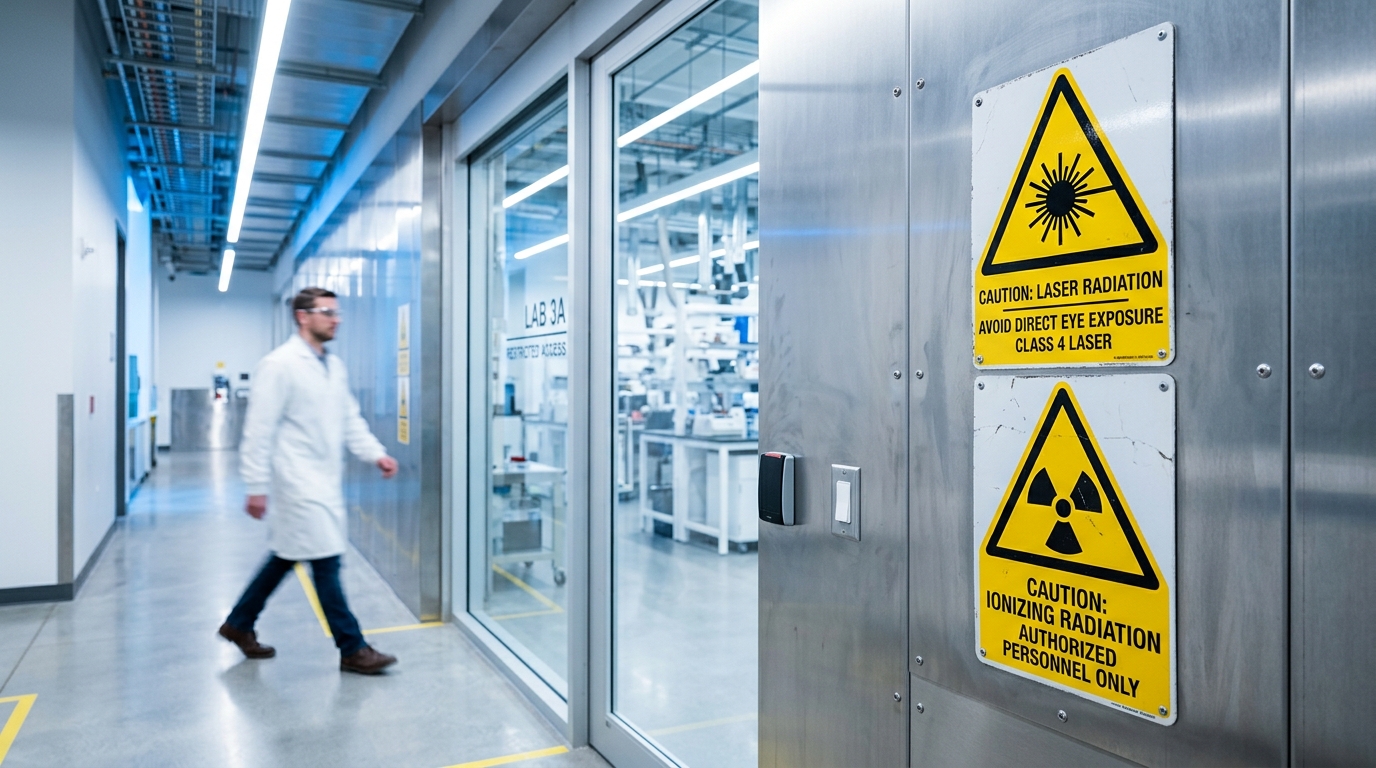
Radiation Protection: Laser Safety Officer and Nuclear Safety Officer
Learn the legal requirements, qualifications, and operational duties for Laser Safety Officers and Nuclear Safety Officers under German compliance laws.
Key Takeaways
- Laser Safety Officers are legally mandatory under Section 5 of the OStrV for all commercial operations using laser classes 3R, 3B, and 4.
- Failing to appoint a certified Laser Safety Officer exposes executives to administrative fines of up to 10000 EUR under German law.
- Nuclear Safety Officers must be appointed under the AtSMV to oversee nuclear facilities and supervise critical reportable events.
- Both safety officer roles require specialized technical training that must be formally documented to ensure corporate compliance.
Radiation Protection: Legal Mandates in the German Workplace
Under German occupational health, safety, and environmental protection laws, employers are legally obligated to protect workers and the general public from the hazards of radiation. The regulatory framework strictly distinguishes between non-ionizing radiation, specifically artificial optical radiation such as industrial lasers, and ionizing radiation, which includes nuclear materials and X-rays. For corporate executive management, compliance is not merely an administrative checkbox. Failing to properly manage these radiation hazards can lead to severe civil liability, operational shutdowns, and personal criminal exposure under German safety statutes. Integrating these safety mandates with the duties of the occupational safety specialist, or Fachkraft für Arbeitssicherheit, is critical to maintaining a legally compliant corporate structure.
The Dual Pillars of Radiation Protection Law
Germany enforces distinct legislative regimes depending on the physical nature of the radiation source utilized in the workplace. Laser applications in manufacturing, medicine, or research are governed by occupational safety regulations that mitigate immediate thermal and optical risks. Conversely, the handling of radioactive substances, X-ray equipment, and nuclear operations is subject to the stringent oversight of federal nuclear and radiation protection laws, designed to prevent long-term ionizing damage and environmental contamination.
| Regulatory Field | Physical Sources Covered | Primary German Statutes | Corporate Officer Role Required |
|---|---|---|---|
| Laser Radiation (Non-Ionizing) | High-power laser systems belonging to classes 3R, 3B, and 4 used in industrial cutting, medical therapy, or measurement. | OStrV (Occupational Safety Ordinance on Artificial Optical Radiation) and the technical rules of TROS Laserstrahlung [[cite:https://www.gesetze-im-internet.de/ostrv/BJNR096010010.html]]. | Laser Safety Officer (Laserschutzbeauftragter) |
| Ionizing & Nuclear Radiation | Nuclear installations, radioactive substances, medical X-ray machines, and radioactive waste facilities. | AtG (German Atomic Energy Act), StrlSchG (Radiation Protection Act) [[cite:https://www.gesetze-im-internet.de/atsmv/BJNR017660992.html]], and AtSMV (Nuclear Safety Officer and Reporting Ordinance). | Radiation Protection Officer ([[link:https://civac.de/roles/strahlenschutzbeauftragter|Strahlenschutzbeauftragter]]) and Nuclear Safety Officer (Kerntechnischer Sicherheitsbeauftragter) |
Operating these high-risk technologies without the formal appointment of qualified safety officers constitutes a direct violation of German labor and environmental law. For executive boards and managing directors, establishing an audit-proof compliance framework is essential to transfer operational tasks while retaining supervisory control. These specialized officers ensure that technical protective measures, regular risk assessments, and mandatory employee instructions are carried out continuously. By leveraging modern compliance structures, international and German enterprises can shield their leadership from personal liability and guarantee uninterrupted operational licenses.
The Laser Safety Officer: Legal Triggers under OStrV and DGUV Rule 11
Under German occupational health and safety law, protecting employees from artificial optical radiation is a mandatory compliance requirement. The primary legal basis for this is Section 5 of the Occupational Health and Safety Ordinance on Artificial Optical Radiation (Arbeitsschutzverordnung zu kuenstlicher optischer Strahlung, or OStrV)[1]. This ordinance is heavily complemented by the German Statutory Accident Insurance regulations, specifically DGUV Rule 11 (DGUV Vorschrift 11), which dictates when commercial operations must designate an internal or external laser safety officer (Laserschutzbeauftragter). The mandate is strictly triggered as soon as a company utilizes laser equipment belonging to laser classes 3R, 3B, or 4. These high-power systems present severe risk of irreversible injury to the human eye and skin, making professional oversight a non-negotiable legal duty.
The Role of Technical Rules and Hidden Risks
To translate the broad framework of the OStrV into practical corporate guidelines, the Federal Institute for Occupational Safety and Health (BAuA) publishes the Technical Rules on Artificial Optical Radiation, known as TROS Laserstrahlung[1]. These rules clarify how risk assessments are conducted and how safety officers must execute their daily duties. One common compliance oversight occurs with laser systems that are classified as safe Class 1 devices during normal production. If maintenance, cleaning, or alignment tasks require removing protective housings and exposing workers to internal beams of Class 3B or 4, a laser safety officer must still be appointed in writing[1]. This appointment should be managed in tandem with the company's occupational safety specialist to ensure all physical safety protocols are embedded within the general risk assessment.
| Laser Class | Risk Profile to Eyes and Skin | Safety Officer Appointment Trigger |
|---|---|---|
| Class 3R | Low to medium hazard. Direct viewing of the beam is potentially dangerous, but injury risks are lower than high-power classes. | Mandatory in writing if the beam poses a direct hazard to workers under normal or maintenance conditions. |
| Class 3B | Medium to high hazard. Direct beam and specular reflections cause immediate eye damage and can harm the skin. | Always mandatory. Requires formal written appointment and certified technical expertise to operate safely. |
| Class 4 | Extreme hazard. Direct beam, specular reflections, and diffuse reflections cause severe, permanent injuries. Also presents a significant fire hazard. | Always mandatory. Demands extensive protective measures, strict area control, and detailed operating instructions. |
Qualification, Training, and Refresher Obligations
An operator cannot simply nominate any employee to this role on short notice. According to the TROS Laserstrahlung guidelines, the appointed officer must possess verified expertise, which is typically acquired by completing a certified training course and passing a final examination[1]. To maintain this legal status, the officer is required to keep their expertise up to date through regular advanced training. In practice, a refresher course is required at least once every five years to account for technical advancements and regulatory updates[1]. This ongoing training ensures that the officer can successfully guide the company's hazard assessments, especially when integrating new technologies or working alongside a certified radiation protection officer in facilities with broader radiation protection mandates.
From an operational standpoint, the written appointment must explicitly outline the officer's concrete tasks, territorial boundaries, and authority, such as the power to immediately shut down laser equipment if safety defects are identified[1]. While the safety officer manages daily monitoring, the ultimate legal and financial liability for risk assessments and protective measures remains with the company's executive management. Failing to appoint a qualified officer when required under OStrV Section 5 represents a severe regulatory violation, exposing the board to substantial fines and personal liability in the event of workplace accidents.
Duties, Qualifications, and Liability of a Laser Safety Officer
In German occupational safety, the appointment of a laser safety officer (Laserschutzbeauftragter) is a strict statutory requirement for companies operating hazardous laser equipment. Under Section 5 of the Occupational Health and Safety Ordinance on Artificial Optical Radiation (OStrV) and supported by DGUV Rule 11, any business employing lasers of classes 3R, 3B, or 4 must designate a competent officer in writing. This role is crucial for managing workplace radiation risks, alongside other safety roles such as a certified radiation protection officer. The primary purpose is to protect employees from irreversible eye and skin damage caused by optical radiation.
Core Duties and Operational Responsibilities
The laser safety officer is tasked with assisting the employer in implementing safety protocols and ensuring compliance. According to the technical rules for laser radiation (TROS Laserstrahlung), their daily responsibilities involve active risk management and field inspections. They must supervise safe operations, ensure that laser equipment is handled only by instructed personnel, and actively support the risk assessment process under Section 3 of the OStrV[2]. When accidents or technical faults occur, they are responsible for immediate incident reporting and coordination of corrective actions.
- Conducting and updating mandatory laser risk assessments (Gefährdungsbeurteilung) in coordination with the occupational safety specialist.
- Defining, designating, and clearly marking laser protection areas (Laserschutzbereiche) with warning signs and technical barriers.
- Selecting, inspecting, and managing appropriate personal protective equipment (PPE), particularly laser safety goggles suited to specific wavelengths.
- Instructing and training employees on laser-specific hazards and safety protocols before they begin operating the equipment.
- Advising the management on technical safety improvements and supervising the safe setup and maintenance of laser systems.
Required Technical Qualifications and Refresher Courses
To be appointed, a laser safety officer must possess the required professional expertise under Section 5, Paragraph 2 of the OStrV. The candidate must have completed a technical, scientific, medical, or cosmetic vocational training program of at least two years, or possess equivalent professional experience. This foundation must be supplemented by the successful completion of an approved laser safety training course[3]. Because laser technology and safety standards evolve rapidly, TROS Laserstrahlung and DGUV guidelines recommend that laser safety officers refresh their technical qualifications through recognized training courses at least once every five years.
| Laser Class | Risk Level | Officer Required? | Key Protective Measures |
|---|---|---|---|
| Class 3R | Low to medium risk; direct beam viewing is potentially hazardous to the eyes. | Yes, if the laser beam is not fully enclosed during normal operation. | Eye protection, clear marking of the laser area, and technical access restrictions. |
| Class 3B | Medium to high risk; direct beam viewing is hazardous to eyes, and diffuse reflections can cause damage. | Yes, mandatory written appointment is always required. | Strict access control, mandatory laser safety goggles, and visual warning lights. |
| Class 4 | High risk; direct and diffuse beams cause severe eye and skin injuries, and pose fire hazards. | Yes, mandatory written appointment is always required. | Interlock systems, fire-resistant shielding, emergency shut-offs, and beam dumps. |
Liability and Regulatory Fine Exposure
Failing to comply with German laser safety regulations carries severe financial and administrative consequences. Under Section 9 of the OStrV, operating classes 3R, 3B, or 4 lasers without appointing a qualified laser safety officer, or failing to carry out risk assessments, constitutes an administrative offense (Ordnungswidrigkeit). Such violations can result in regulatory fines of up to 10,000 EUR. Furthermore, in cases where negligence leads to workplace accidents and bodily harm, personal civil and criminal liability risks apply to both executive directors and safety managers. Leveraging digital compliance management tools like the CIVAC Workspace helps organizations manage appointments, document risk assessments, and schedule mandatory refreshers to remain fully audit-proof.
The Nuclear Safety Officer: Legal Framework under AtG, StrlSchG, and AtSMV
Under German law, high-risk industrial installations handling nuclear fuels must maintain strict compliance mechanisms to prevent severe accidents and environmental exposure. The legal foundation for appointing a Nuclear Safety Officer (kerntechnischer Sicherheitsbeauftragter) is established by the German Atomic Energy Act (Atomgesetz - AtG) and defined under Section 2 of the Nuclear Safety Officer and Reporting Ordinance (Atomrechtliche Sicherheitsbeauftragten- und Meldeverordnung - AtSMV)[4]. Operating any facility licensed under Section 7 Paragraph 1 of the AtG triggers a mandatory obligation to appoint both a qualified Nuclear Safety Officer and an official deputy in writing. This obligation spans from initial operations through decommissioning up until the site is certified completely free of nuclear fuel.
While the core appointment obligation targets active facilities, other specialized activities (such as nuclear waste storage under Section 6 AtG, decommissioning projects under Section 7 Paragraph 3 AtG, and radioactive waste treatment facilities) fall under the broader regulatory scope of the Radiation Protection Act (Strahlenschutzgesetz - StrlSchG). To manage these distinct domains, organizations frequently must also appoint a dedicated Radiation Protection Officer to handle occupational safety and environmental monitoring. The AtSMV provides minor exemptions only under highly restricted thresholds, such as for low-power research facilities under 50 kilowatts of thermal capacity or sites with limited radioactive inventories[4].
Core Duties and Operational Responsibilities
The Nuclear Safety Officer functions as an independent, internal advisor to the operator, tasked with supervising all safety-relevant workflows. Rather than managing daily operations directly, their responsibility is systemic and advisory. They evaluate safety systems, oversee reporting procedures, and ensure that any technical deviations are mitigated. According to Section 4 of the AtSMV, the officer must investigate all reportable safety-relevant events, document these occurrences, and coordinate the formal notification process to the competent state supervisory authority without delay[4].
- Monitoring compliance with nuclear regulations, license conditions, and administrative orders.
- Assessing the safety implications of procedural changes and technical modifications within the facility.
- Investigating and documenting all incidents, near-misses, and safety-critical anomalies.
- Advising the operating company's management on modern safety practices and risk mitigation.
- Developing and overseeing internal reporting systems to ensure that reportable events under the AtSMV are immediately identified and registered.
Qualification, Documentation, and Liability
To ensure compliance, candidates for this role must possess exceptional qualifications. According to Section 2 Paragraph 3 of the AtSMV, the operator must verify that the appointed officer possesses both personal reliability (Zuverlässigkeit) and the highly specialized technical expertise (Fachkunde) required for nuclear safety[4]. Documentation of this expertise must be submitted to the supervisory authority immediately upon appointment. This formal notification must outline the officer's position within the corporate hierarchy, and a duplicate must be handed over to the works council (Betriebs- oder Personalrat) to guarantee compliance transparency.
| Compliance Parameter | Nuclear Safety Officer Requirement |
|---|---|
| Legal Mandate | Section 2 Paragraph 1 AtSMV in conjunction with Section 7 AtG |
| Target Facilities | Nuclear power stations, research reactors, and processing facilities under Section 7 Paragraph 1 AtG |
| Required Qualifications | Proven personal reliability and verified technical nuclear safety expertise (Fachkunde) |
| Filing Obligations | Immediate written notification of appointment to the state supervisory authority and works council |
| Core Liability Risk | Administrative fines under the AtG for failure to appoint or failure to report nuclear incidents immediately |
Failing to appoint a qualified officer, or neglecting the mandated reporting deadlines for safety incidents under the AtSMV, exposes the executive board and HSE directors to significant administrative fines. Under the German Atomic Energy Act, missing reporting deadlines or operating without the required corporate officers constitutes a regulatory offense. Beyond civil fines, corporate managers can face severe criminal liability under the German Criminal Code (Strafgesetzbuch - StGB) if negligent supervision leads to radioactive release or compromises public health.
Mandatory Duties, Qualifications, and Reporting Protocols in Nuclear Safety
Operating nuclear or high-radiation installations in Germany requires strict adherence to specialized corporate officer roles. Under § 2 of the Nuclear Safety Officer and Reporting Ordinance (Atomrechtliche Sicherheitsbeauftragten- und Meldeverordnung, or AtSMV), operators must appoint a qualified nuclear safety officer (kerntechnischer Sicherheitsbeauftragter). This role represents a highly specialized position under the umbrella of German nuclear safety regulations, established to prevent hazardous events and maintain operational compliance alongside the standard radiation protection officer (Strahlenschutzbeauftragter) who manages radiological protection protocols.
Core Responsibilities and Direct Escalation Rights
The operational duties of the nuclear safety officer are explicitly outlined in § 4 AtSMV. The officer is responsible for evaluating reportable events (meldepflichtige Ereignisse) under § 6 AtSMV and its detailed Annex 4, analyzing plant disruptions, and monitoring operating experience from other nuclear facilities to prevent similar failures. Crucially, § 5(2) AtSMV grants the nuclear safety officer a powerful statutory escalation right. If the officer identifies a critical safety concern and cannot reach an agreement with the plant manager, they have the legal right to present their concerns directly to the company's executive board. If the executive directors choose to reject a formal safety recommendation, they must justify their decision in writing and submit copies to the state supervisory authority and the company's Works Council.
Strict Approval Process and Management Liability
Given the high stakes of nuclear operations, managing directors cannot simply assign this role internally by standard appointment. Candidate selection is subject to a strict government approval process by the competent state ministry. To secure approval, candidates must demonstrate both specialized technical expertise (Fachkunde) and absolute personal reliability. For executive directors, failing to implement this safety oversight function correctly carries severe legal consequences. Negligent safety oversight or failing to report mandatory events can lead to administrative fines of up to 50,000 EUR under the German Atomic Energy Act (Atomgesetz, or AtG), and managing directors face personal criminal prosecution under the German Criminal Code (Strafgesetzbuch, or StGB) for unauthorized nuclear operations.
- Legal Basis: Mandatory appointment under § 2 AtSMV and the German Atomic Energy Act (AtG) for operators of nuclear facilities.
- Statutory Duties: Overseeing reportable events, tracking plant malfunctions, and evaluating safety modifications under § 4 AtSMV[5].
- Direct Escalation: Explicit right under § 5(2) AtSMV to bypass site management and report safety conflicts directly to the executive board[6].
- Authority Approval: Requires official state verification of specialized technical expertise and candidate reliability before formal appointment.
- Liability Risks: Personal criminal liabilities for executives under the German Criminal Code (StGB) alongside substantial administrative fines under the AtG.
Digitalizing Compliance: How CIVAC Simplifies Radiation and Laser Safety
Managing highly specialized corporate roles, such as laser safety officers (OStrV § 5) and nuclear safety officers under the Atomic Energy Act, presents immense administrative pressure. For managing directors, compliance officers, and HSE leads, keeping track of complex training intervals, technical reports, and regulatory documentation is often a manual, error-prone task. This manual oversight can quickly lead to personal liability risks and massive corporate fines. Modern enterprises with German operations are increasingly transitioning away from spreadsheets and physical folders, adopting digital systems to maintain audit-proof compliance.
Streamlined Management with CIVAC Workspace
The digital CIVAC Workspace acts as a centralized compliance hub, bringing order to the operational complexities of radiation and laser safety. Designed specifically for internal safety officers and environmental coordinators, the software coordinates mandatory tasks, schedules, and regulatory documentation. In high-stakes environments such as laser facilities or medical centers, the system automatically tracks the required refresher courses for appointed staff to ensure certifications never lapse[7].
- Automated recurrence tracking for mandatory laser safety and radiation training intervals.
- Centralized digital archive for official appointment certificates and regulatory notifications.
- Integrated task management to delegate radiation measurement protocols and equipment inspections.
- Access to a comprehensive library of over 905 ready-to-use compliance and risk-assessment templates.
Legally Secure External Staffing
When internal technical expertise is unavailable, or when companies wish to minimize their direct administrative overhead, they can turn to CIVAC Externe Beauftragte. This managed compliance service provides certified, external experts to legally step into designated corporate officer roles. By appointing an external radiation protection officer, companies secure certified expertise that satisfies the stringent standards of the German Radiation Protection Act (StrlSchG) and the Atomic Energy Act (AtG) without having to train staff internally.
Ultimately, a digital-first approach to radiation protection and laser safety minimizes operational friction. By utilizing automated workflows for audit preparation and professional external appointments, corporate leaders can protect their organizations from regulatory exposure while focusing on core business growth.
Frequently Asked Questions
When is a German company legally required to appoint a Laser Safety Officer?
Under Section 5 of the Occupational Health and Safety Ordinance on Artificial Optical Radiation (OStrV), a company must appoint a Laser Safety Officer (Laserschutzbeauftragter) if it operates lasers of class 3R, 3B, or 4. These laser classes present high optical risks to the eyes and skin, making professional supervision and specialized risk assessment mandatory to prevent occupational accidents.
What are the qualification requirements for a German Laser Safety Officer?
An eligible individual must possess the necessary technical knowledge, typically proven through successful completion of a certified training course. Under German accident prevention regulations (DGUV Rule 11 and TROS Laserstrahlung), this training must cover laser physics, biological effects, protective measures, and hazard assessments. Additionally, qualifications must be kept up-to-date with regular refresher courses, typically recommended at least once every 5 years.
What is the legal basis for appointing a Nuclear Safety Officer in Germany?
The legal basis is anchored in the German Atomic Energy Act (AtG), the Radiation Protection Act (StrlSchG), and specifically the Nuclear Safety Officer and Reporting Ordinance (AtSMV). Under these statutes, operators of nuclear facilities, research reactors, and nuclear waste storage sites must formally appoint a qualified Nuclear Safety Officer to supervise safety protocols and reportable events.
What are the main duties of a Nuclear Safety Officer under the AtSMV?
Under the Nuclear Safety Officer and Reporting Ordinance (AtSMV), the officer is responsible for supervising nuclear safety, verifying that all systems comply with regulatory standards, and reviewing reportable events. The safety officer must verify that reportable events are documented accurately and transmitted to the regulatory authorities without delay, holding an independent reporting line directly to executive management.
Can companies outsource these officer roles to external providers in Germany?
Yes. Many organizations choose to fulfill their compliance requirements by appointing external safety officers. Services like CIVAC Externe Beauftragte allow companies to appoint certified, external professionals who assume the legal duties of these roles. This provides instant expertise, reduces internal training costs, and minimizes operational liability for executive management.
What are the penalties for non-compliance with these safety officer mandates?
Failing to appoint a required Laser Safety Officer is an administrative offense under Section 9 of the OStrV, carrying fines of up to 10000 EUR. In the nuclear sector, non-compliance with safety mandates or failing to report incidents under the AtSMV is treated with extreme severity, exposing managing directors and responsible individuals to massive administrative fines or criminal prosecution under the German Penal Code.
Sounds like a lot of work?
Officer duties, deadlines, paperwork — that's exactly what we take off your hands. Say hello and we'll show you how.
The officer role behind this article
Sources
- laserschutzseminar.de
- gesetze-im-internet.de
- publikationen.dguv.de
- gesetze-im-internet.de
- gesetze-im-internet.de
- gesetze-im-internet.de
- lzh-laser-akademie.de
- Audit-Vorbereitung mit CIVAC
- Leistungen von CIVAC
- Die CIVAC Compliance-Plattform
- Fachkraft für Arbeitssicherheit (SiFa)
- Strahlenschutzbeauftragter § 70 StrlSchG bestellen
Turn this into a mandate.
Let us carry the operational weight. External officer, templates and documentation in one workspace. No obligation.

Sections 6, 17, 45 ElektroG: registration before placing on the market, take-back from 400 square metres, fines up to EUR 100,000