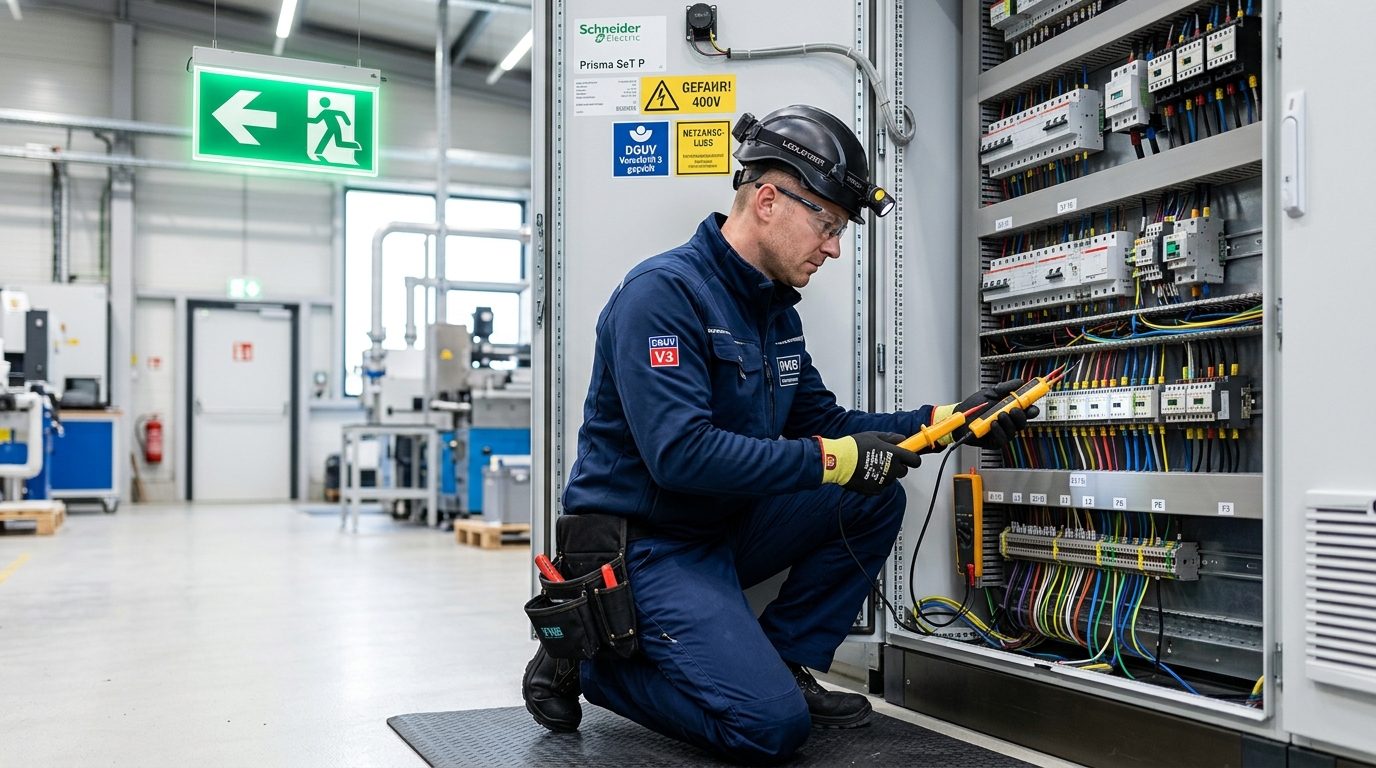
Qualified Electrician and Inspection of Electrical Installations under DGUV V3
Ensure compliance with DGUV V3 and ASR A3.4 by correctly appointing a VEFK and lighting competent person. Avoid heavy management liability and fines.
Key Takeaways
- The VEFK assumes full technical responsibility for low-voltage systems up to 1000 volts, protecting executives from personal liability.
- Emergency lighting systems must undergo regular tests, maintaining a minimum illuminance of 1 lux along escape routes under ASR A3.4.
- Batteries for self-contained emergency lighting require capacity to power escape route signage for a minimum of 3 hours upon grid failure.
- Failing to properly delegate electrical duties under DGUV V3 can result in direct management liability, criminal charges, and heavy fines.
Understanding German Electrical Safety: The Legal Mandate under DGUV V3
Operating a business in Germany comes with a rigorous regulatory burden, particularly concerning workplace health and safety. At the core of these requirements is the employer's duty of care, a legal obligation to protect employees from occupational hazards. When it comes to electrical installations and equipment, this duty is governed by a strict network of state laws and accident prevention regulations. For managing directors, compliance leads, and health, safety, and environment (HSE) officers, understanding these obligations is critical to avoiding heavy organizational liability and ensuring business continuity.
The primary operational standard for electrical safety is the accident prevention regulation DGUV Vorschrift 3 (often referred to as DGUV V3), issued by the German Social Accident Insurance. DGUV V3 mandates that employers ensure all electrical installations and equipment are installed, modified, and maintained in a safe condition before their first commissioning and at regular intervals thereafter[1]. Failure to adhere to these strict inspection cycles can result in immediate operational shutdowns, loss of insurance coverage, and severe corporate penalties if an electrical accident occurs.
| Legal Level | Statutory Source | Primary Focus & Implication |
|---|---|---|
| Civil Law | German Civil Code (BGB) Section 823 | Establishes personal and corporate liability for damages caused by negligent failure to maintain safe electrical systems. |
| State Law | Industrial Safety Regulation (BetrSichV) | Defines statutory duties for providing safe work equipment, conducting risk assessments, and determining testing intervals. |
| Accident Prevention | DGUV Regulation 3 (DGUV V3) | Specifies the technical execution, inspection procedures, and qualification requirements for testing electrical installations. |
The statutory landscape is further reinforced by the German Industrial Safety Regulation (Betriebssicherheitsverordnung, or BetrSichV), which requires companies to carry out comprehensive risk assessments (Gefährdungsbeurteilungen) for all workplace machinery and tools. Crucially, when an accident occurs due to poorly maintained electrical equipment, the legal consequences trace back to Section 823 of the German Civil Code (Bürgerliches Gesetzbuch, or BGB). BGB Section 823 imposes strict liability for damages on any individual who, willfully or negligently, unlawfully injures the life, body, health, or property of another, making the failure to implement DGUV V3 inspections a direct path to personal executive liability.
Navigating this complex legal environment requires structured organizational oversight. Many international groups with German operations and mid-market companies manage these legal roles by appointing a dedicated compliance officer to monitor schedules, delegate technical responsibilities, and ensure that all documentation is audit-proof. This proactive structure transforms electrical safety from a recurring risk into a standardized, manageable compliance process.
The Responsible Qualified Electrician (VEFK): DIN VDE 1000-10 Requirements
Managing directors of international and German companies often face a challenging regulatory gap when trying to mitigate workplace electrical hazards. Since corporate executives rarely possess a formal electrotechnical background, they cannot legally assume direct technical responsibility for electrical systems. Under the German Industrial Safety Regulation (Betriebssicherheitsverordnung) and the accident prevention regulation DGUV Vorschrift 3, the duty of care remains non-delegable unless a structured delegation of authority occurs. This is where appointing a Responsible Qualified Electrician, known in Germany as the Verantwortliche Elektrofachkraft (VEFK), becomes a core compliance requirement under DIN VDE 1000-10. The VEFK acts as the central technical officer, assuming full technical responsibility (Fachverantwortung) for the organization's entire electrotechnical infrastructure, thereby shielding managing directors from potential organizational culpability (Organisationsverschulden) in the event of an electrical accident[2].
To legally fulfill this critical oversight role, the VEFK must satisfy stringent personal, professional, and regulatory qualifications defined by DIN VDE 1000-10 and the Technical Rules for Operational Safety (TRBS 1203). The individual must hold a recognized credential in electrical engineering, such as a university degree, a master craftsman certificate (Meister), or a state-certified technician qualification. Furthermore, TRBS 1203 mandates that a competent person for electrical testing must possess up-to-date specialized knowledge, which requires regular participation in professional training and active practical involvement in the electrotechnical field. Because the VEFK is tasked with the ultimate organization of testing for both fixed installations and portable devices, they must deeply understand how to execute hazard assessments and structure safe work procedures in accordance with the German Social Accident Insurance (DGUV) standards.
Core Duties and Organizational Authority of the VEFK
The day-to-day responsibilities of a VEFK revolve around building and supervising an airtight corporate electrical safety organization. This includes determining the appropriate inspection intervals for all electrical equipment, choosing qualified internal or external inspectors, and reviewing testing documentation to ensure it is audit-proof. Crucially, the VEFK exercises supervisory authority over other Qualified Electricians (EFK) and Electrotechnically Instructed Persons (EuP), ensuring that no unauthorized personnel attempt dangerous electrical tasks. To function effectively, the VEFK must be formally appointed in writing, outlining a clear delegation of duties. According to German labor safety rules, the VEFK must be granted technical independence, meaning they cannot be legally overruled on technical safety decisions by non-technical managers or corporate officers.
| Role and German Title | Core Technical Responsibility | Required Qualification under German Standards |
|---|---|---|
| Responsible Qualified Electrician (VEFK) | Overall electrical safety organization, defining testing intervals, and technical supervision of all electrical work. | Electrical engineer, master craftsman (Meister), or state-certified technician with continuous practical experience under TRBS 1203. |
| Qualified Electrician (EFK) | Independent execution of electrical installations, modifications, maintenance, and mandatory safety testing. | Completed vocational training in electrical engineering with proven professional experience in the relevant specialized field. |
| Electrotechnically Instructed Person (EuP) | Assisting with basic and predefined electrical tasks under the instruction and strict supervision of an EFK or VEFK. | Documented briefing on safety rules, specific risks, and protective measures, which must be repeated on an annual basis. |
Managing this complex web of technical responsibilities, training cycles, and mandatory testing protocols can easily overwhelm corporate compliance and HSE departments. The VEFK does not work in isolation but must closely collaborate with other workplace safety roles, such as the appointed occupational safety specialist or the corporate physician. To prevent administrative friction and ensure that appointment certificates, risk assessments, and test logs are stored in a legally defensible manner, companies increasingly rely on modern digital compliance ecosystems. Implementing a centralized compliance software solution like the CIVAC Workspace enables compliance officers and managing directors to maintain real-time visibility over critical test deadlines and safety assignments across all operational units.
Competent Person for Lighting Installations: Ensuring Safe Workplaces under ASR A3.4
Adequate illumination is a cornerstone of occupational safety, visual comfort, and emergency preparedness. Under German workplace regulations, employers are legally required to install and maintain compliant lighting systems. The core legal basis is the Workplace Ordinance (Arbeitsstättenverordnung - ArbStättV) in conjunction with the Technical Rules for Workplaces ASR A3.4 (Arbeitsstättenregel ASR A3.4)[3]. Furthermore, for safety and emergency lighting, Section 14 of the Ordinance on Industrial Safety and Health (Betriebssicherheitsverordnung - BetrSichV) and the Technical Rules for Operational Safety TRBS 1203 (Technische Regeln für Betriebssicherheit) require inspections by a specifically designated competent person (zur Prüfung befähigte Person). This specialist ensures that general artificial lighting and safety-critical backup systems satisfy both statutory safety demands and European standards such as DIN EN 12464-1.
Concrete Duties and Technical Requirements
The competent person for lighting installations is tasked with a wide range of analytical and inspection duties. They must periodically measure and evaluate illuminance levels (measured in lux) to guarantee they match the minimum requirements prescribed for specific work tasks in DIN EN 12464-1 and ASR A3.4. For instance, standard office spaces typically require a minimum of 500 lux. Beyond general workspace illumination, they oversee the complex functional testing of emergency and safety lighting. This includes inspecting escape route indicators, backup power sources, and emergency path illumination to guarantee safe evacuation during a power outage. These emergency installations must be cross-referenced with general workplace escape routes and escape route signage rules under ASR A2.3 to establish a seamless, auditable safety concept.
| System Type | Key Standards | Mandatory Testing Frequency | Typical Requirements |
|---|---|---|---|
| General Workplace Lighting | ASR A3.4, DIN EN 12464-1 | Recommended annually or during major structural changes | Minimum lux levels (e.g., 500 lx for offices), glare control, and color rendering |
| Emergency & Safety Lighting | BetrSichV, DIN EN 50172, DIN VDE 0108-100 | Weekly visual checks, monthly functional tests, annual full-duration test | Immediate activation upon power failure, minimum 1 lx along centerlines of escape routes |
| Escape Route Indicators | ASR A2.3, DIN EN ISO 7010 | Regular visual and functional inspections | Continuous visibility, correct color schemes, and proper backlighting or illumination |
Required Qualification, Appointment, and Liability
To be appointed as a competent person (befähigte Person) for inspecting emergency and safety lighting systems under TRBS 1203, an individual must possess technical professional training (such as an electrical engineering degree or training as a qualified electrician), relevant professional experience in lighting technology, and active, recent experience conducting similar testing. The employer must formally appoint this officer in writing, clearly outlining their precise areas of responsibility, authority, and geographic scope. Managing these appointments and maintaining their records can be streamlined using specialized software like the CIVAC Workspace, which secures audit-proof tracking of required qualifications and automated alerts for upcoming inspections. Employers who fail to designate a qualified competent person, or who neglect the mandatory periodic testing of safety lighting, face substantial legal exposure. Under Section 22 of the ArbStättV and relevant occupational health laws, failure to maintain compliant workplace lighting is classified as an administrative offense, punishable by severe administrative fines. If an uninspected safety lighting system fails during an emergency and leads to personal injury, executive directors and HSE leads face direct personal criminal liability for negligent bodily harm.
- Legal Mandate: Based on ArbStättV, ASR A3.4, BetrSichV Section 14, and TRBS 1203.
- Technical Benchmarks: Adherence to DIN EN 12464-1 for general illumination and DIN EN 50172 for safety systems.
- Key Tasks: Periodic measurement of lux levels, functional testing of emergency power supplies, and verification of escape route indicators.
- Qualification Criteria: Formal electrical or technical background, practical experience with lighting systems, and up-to-date knowledge via continuous training.
- Compliance Penalty: Breaches represent administrative offenses subject to heavy regulatory fines and direct executive liability in the event of accidents.
Organizational Fault and Executive Liability: The Risks of Poor Appointment
In Germany, executive boards, managing directors, and health, safety, and environment (HSE) leads cannot simply assume that electrical safety is a low-level operational matter. Under the doctrine of organizational fault (Organisationsverschulden), company leaders bear ultimate statutory responsibility for the safety of all electrical installations and equipment within their facilities. If an organization fails to formally appoint a Responsible Qualified Electrician (Verantwortliche Elektrofachkraft, or VEFK) or a competent person for lighting installations, this legal duty remains at the executive level[4]. In the event of an electrical accident, the lack of an explicit, qualified delegation of power is legally construed as a systemic management failure rather than an isolated worker error. Managing directors and HSE leads are the primary target groups who must actively manage these corporate risks, often collaborating with an internal compliance officer to establish a clear delegation hierarchy.
The Interplay of OWiG Section 130 and StGB Section 14
The legal mechanism of this personal exposure is anchored in several German statutory codes. The German Act on Regulatory Offences (Ordnungswidrigkeitengesetz, or OWiG) Section 130 explicitly penalizes the breach of supervisory duties in businesses and operations. Under Section 130, if an executive fails to implement proper supervisory measures, which includes appointing qualified personnel and ensuring mandatory inspections under DGUV V3, the company faces substantial regulatory fines[5]. These administrative fines can reach up to one million euros under OWiG Section 130 Section 3 for negligent supervisory breaches. Concurrently, Criminal Code (Strafgesetzbuch, or StGB) Section 14 establishes that executives and appointed representatives are personally liable for fulfilling these corporate duties, meaning that HSE leads and managing directors cannot easily deflect blame to subordinates in criminal investigations.
| Liability Category | Statutory Source | Primary Legal Consequence | Executive Risk Trigger |
|---|---|---|---|
| Regulatory Offences | OWiG Section 130 | Corporate fines up to one million euros | Failure to supervise, audit, or correctly appoint qualified officers like a VEFK |
| Criminal Liability | StGB Section 14 | Personal criminal prosecution and imprisonment | Direct representation of the entity when bodily harm or fatal electrical accidents occur |
| Civil Liability | BGB Section 823 | Unlimited personal liability for damages | Negligence resulting in injury to health, life, or property without proper documentation |
To prevent such severe liability, executives must ensure that the delegation of electrical responsibility is completely transparent and meticulously documented. Proper appointment letters must be drafted, and qualification credentials must be verified before any task delegation is finalized. When companies fail to establish a systematic approach to these appointments, they leave themselves open to civil damage claims under Civil Code (Bürgerliches Gesetzbuch, or BGB) Section 823. Implementing a modern compliance platform can streamline this process by maintaining an audit-proof, centralized repository of appointment certificates and inspection protocols.
Digitalizing Compliance: How CIVAC Simplifies Electrical Safety Operations
Managing complex electrical safety compliance under German accident prevention regulations requires meticulous coordination. Corporate directors and HSE managers often find themselves buried in administrative friction, trying to synchronize different inspection schedules for portable devices and permanent installations. Ensuring that a responsible qualified electrician (VEFK) and a competent person for lighting are properly appointed, trained, and documented is a monumental task. The CIVAC Workspace provides a unified digital solution, replacing outdated spreadsheet systems with automated compliance workflows designed specifically for modern operations.
One of the biggest hurdles in maintaining DGUV V3 compliance is tracking the highly variable testing intervals for electrical assets. For instance, stationary electrical installations are usually inspected every four years, while highly stressed portable equipment on construction sites or factory floors may require testing every three to six months[6]. Failing to keep up with these timelines can lead to severe fines and voids insurance coverage in the event of an accident. Through the compliance platform, internal teams can coordinate recurring testing tasks, manage mandatory training programs for competent personnel, and generate legally resilient records that withstand regulatory audits.
| Tracking Parameter | Traditional Manual Process | CIVAC Workspace Solution |
|---|---|---|
| Inspection Deadlines | Manual spreadsheets prone to missed intervals | Automated recurring notifications for VEFK tasks |
| Documentation and Auditing | Physical folders or scattered PDF test reports | Audit-proof digital repository linked to compliance roles |
| Mandatory Training | Difficult tracking of recurring competent person renewals | Integrated learning tracking for HSE teams |
Offloading Corporate Liability with CIVAC Externe Beauftragte
In many cases, organizations lack the internal capacity or specialized technical expertise to appoint a full-time VEFK or competent person for lighting. When internal appointments are impractical, organizations can leverage CIVAC services to delegate these responsibilities. Through the service tier CIVAC Externe Beauftragte, companies can appoint legally compliant external officers. This managed compliance service transfers functional responsibility and liability from the board of directors to certified, pre-vetted specialists who execute inspections and maintain active oversight of all electrical safety operations.
By digitizing these critical workflows, businesses ensure that their compliance track record remains continuous and easily verifiable. Whether managing internal specialists or utilizing external appointments, the platform streamlines the entire process from initial task assignment to final audit preparation. This structured oversight eliminates administrative blind spots, protects employees, and keeps operations fully aligned with rigorous German safety standards.
Frequently Asked Questions
What is a VEFK and is every company required to appoint one?
A VEFK (Verantwortliche Elektrofachkraft) is a Responsible Qualified Electrician under DIN VDE 1000-10. Any company employing electrical specialists (EFK) or carrying out electrical tasks must appoint a VEFK to assume technical responsibility. Without a designated VEFK, the ultimate liability for electrical safety remains directly with the managing directors, who usually lack the technical qualification to supervise such dangerous work.
What qualifications must a Responsible Qualified Electrician (VEFK) possess?
According to DIN VDE 1000-10 and TRBS 1203, a VEFK must be a state-certified technician, master craftsman (Meister), or hold an engineering degree in electrical engineering. They must also demonstrate recent professional experience in the field of electrical installations and participate in regular training to keep their technical knowledge up to date.
What are the testing requirements for emergency lighting under ASR A3.4?
Technical workplace rule ASR A3.4 requires emergency and safety lighting systems to be tested regularly to ensure operational safety. Under standards like DIN EN 50172, this includes short monthly functional checks and a comprehensive annual test. The escape route emergency lights must maintain a minimum illuminance of 1 lux to ensure safe evacuation.
Can a company appoint an external VEFK?
Yes, a company can mandate an external VEFK to fulfill its statutory duties, which is particularly beneficial for small to medium enterprises that lack qualified internal personnel. Legally compliant models like CIVAC Externe Beauftragte provide companies with certified external officers who assume the required technical duties, protecting the management from organizational fault liability.
What are the financial and legal penalties for violating DGUV V3 rules?
Violations of DGUV V3 inspection requirements are classified as regulatory offenses under the German Act on Regulatory Offences (OWiG) and can carry fines up to EUR. In the event of a severe accident, executives face personal criminal charges for negligent bodily injury under Criminal Code Section 229, plus complete loss of commercial liability insurance coverage
Sounds like a lot of work?
Officer duties, deadlines, paperwork — that's exactly what we take off your hands. Say hello and we'll show you how.
The officer role behind this article
Sources
- publikationen.dguv.de
- externe-vefk.de
- baua.de
- mps-heidenheim.de
- gesetze-im-internet.de
- en.calima.io
- Audit-Vorbereitung mit CIVAC
- Leistungen von CIVAC
- Externe SiFa beauftragen: Pflicht, Auswahl und auditfeste Bestellung
- Fluchtwege-Beschilderung nach ASR A2.3: Vorgaben, Pflichten und Audit-Nachweis
- Die CIVAC Compliance-Plattform
- Compliance-Beauftragter: Pflichten, Bestellung, AI Act 2026
Turn this into a mandate.
Let us carry the operational weight. External officer, templates and documentation in one workspace. No obligation.

Sections 6, 17, 45 ElektroG: registration before placing on the market, take-back from 400 square metres, fines up to EUR 100,000