Fire Safety Assistants and Evacuation Marshals: Duties under ASR A2.2
Understand your legal duties for fire safety assistants and evacuation marshals under ASR A2.2 and DGUV. Ensure compliance and protect your business.
Key Takeaways
- Section 10 of the German ArbSchG mandates that employers appoint trained staff for firefighting and emergency evacuation procedures.
- ASR A2.2 requires at least 5% of employees to be trained as fire safety assistants (Brandschutzhelfer) under normal fire risk levels.
- Fire safety assistant training must include at least 2 theoretical units of 45 minutes each, complemented by practical extinguisher drills.
- Failing to document appointments and regular refresher training exposes directors to administrative fines of up to 30,000 EUR.
Introduction: Fire Safety in German Workplaces
In Germany, workplace fire safety is not a voluntary initiative but a strict statutory requirement. Under Section 10 of the German Occupational Health and Safety Act (Arbeitsschutzgesetz - ArbSchG), employers are legally obligated to establish effective emergency measures, including firefighting, first aid, and evacuation protocols. To translate these high-level statutory requirements into practical workplace standards, the German Federal Ministry of Labour and Social Affairs issues Technical Rules for Workplaces (Technische Regeln für Arbeitsstätten). Specifically, ASR A2.2 outlines the concrete technical and organizational measures employers must implement to protect staff and visitors from fire hazards in commercial properties[1].
The Necessity of Systematic Risk Assessments
The scale of fire protection measures is determined by a systematic workplace risk assessment (Gefährdungsbeurteilung). Employers and Health, Safety, and Environment (HSE) leads must evaluate whether their facility presents a normal hazard level, such as a standard office building, or an increased hazard level, which is typical for chemical processing plants, warehouses, or hotels[2]. This assessment dictates the exact number of specialized corporate officers required, the level of technical installations needed, and the specific training protocols for the workforce. Managing directors must ensure these risk assessments are kept up-to-date to prevent severe compliance gaps.
- To ensure a rapid and orderly evacuation of all employees and visitors during an emergency.
- To suppress initial small-scale fires using portable extinguishers without risking personal safety.
- To act as a trained, calm point of contact for external emergency services and public fire departments.
- To assist management in identifying and reporting daily fire hazards within the workplace.
For compliance and HSE officers, building a robust corporate emergency response system requires appointing two distinct operational roles: fire safety assistants (Brandschutzhelfer) and floor wardens or evacuation marshals (Evakuierungshelfer). While larger or high-risk facilities may also require a designated Brandschutzbeauftragter (fire safety officer) to oversee the complete fire concept, every workplace must establish these localized operational roles to execute emergency plans. Furthermore, these designated roles complement the mandatory fire safety training that must be provided to all staff members on a regular, annual basis.
Failing to properly appoint, train, and document these corporate officers is not merely an administrative oversight. Under German regulations, a lack of compliance can lead to significant direct liability for managing directors, invalidation of commercial property insurance policies, and severe regulatory fines during safety audits. The following sections provide a detailed legal and practical breakdown of the duties, training requirements, and liability rules for both fire safety assistants and evacuation marshals under ASR A2.2.
Fire Safety Assistants (Brandschutzhelfer): Legal Duties and Training
In Germany, appointing fire safety assistants (Brandschutzhelfer) is a strict statutory requirement for employers. The legal basis is anchored in Section 10 of the German Occupational Health and Safety Act (Arbeitsschutzgesetz - ArbSchG), which mandates that employers must designate employees responsible for first aid, firefighting, and evacuation. This general obligation is concretized by the Technical Rule for Workplaces ASR A2.2 (Maßnahmen gegen Brände) and further detailed in the DGUV Information 205-023 guideline[3]. For compliance officers and managing directors, ensuring the correct quota and proper training of these corporate officers is essential to minimize operational liability and meet German regulatory standards.
Under standard operating conditions with normal fire hazards, ASR A2.2 establishes a staffing threshold of 5 percent of the total workforce. However, a simple 5 percent calculation is rarely sufficient in practice. Employers must conduct a thorough risk assessment (Gefährdungsbeurteilung) to determine whether a higher quota is required. Factors such as shift work, seasonal absences, sickness, holidays, and increased fire hazards (for example, in chemical processing or woodworking) regularly demand a larger pool of trained assistants to guarantee that fire safety personnel are physically present in the building at all times.
- Legal basis: Section 10 ArbSchG, Technical Rule ASR A2.2, and DGUV Information 205-023
- Standard staffing quota: At least 5 percent of the active workforce, adjusted upward for shift work and absences
- Core duty: Fighting initial fires (Entstehungsbrände) and supporting emergency evacuations without self-endangerment
- Required training: Theory instruction plus a practical fire extinguishing drill, lasting 3 to 4 hours in total
- Refresher interval: Every 2 to 5 years, or immediately following significant operational changes
Concrete Duties and Operational Responsibilities
The primary objective of a fire safety assistant is to prevent small fires from turning into catastrophic events. Their concrete responsibilities include fighting incipient fires (Entstehungsbrände) using portable fire extinguishers or wall hydrants, raising the alarm in the event of an emergency, and assisting in the orderly evacuation of the workforce. They often work in close coordination with the company's designated fire safety officer (Brandschutzbeauftragter) to monitor structural escape routes, ensure fire doors remain unobstructed, and report potential fire hazards to the safety department.
Training, Documentation, and Liability Exposure
To qualify as a fire safety assistant, employees must undergo a certified training program that complies with DGUV Information 205-023. This training must include a theoretical phase covering fire chemistry, proper behavior during emergencies, and structural fire protection, alongside a practical, hands-on extinguishing exercise. Standard workplace safety instructions cannot substitute for this certified course, which must be accompanied by the required annual fire safety training for general staff. All appointments must be documented in writing, and certificates must be kept in an audit-proof format. Failing to appoint or train a sufficient number of assistants constitutes a regulatory offense under the ArbSchG, exposing managing directors to fines of up to 30,000 euros and personal civil liability in the event of injury.
Evacuation Marshals (Räumungshelfer): Ensuring Orderly Building Evacuation
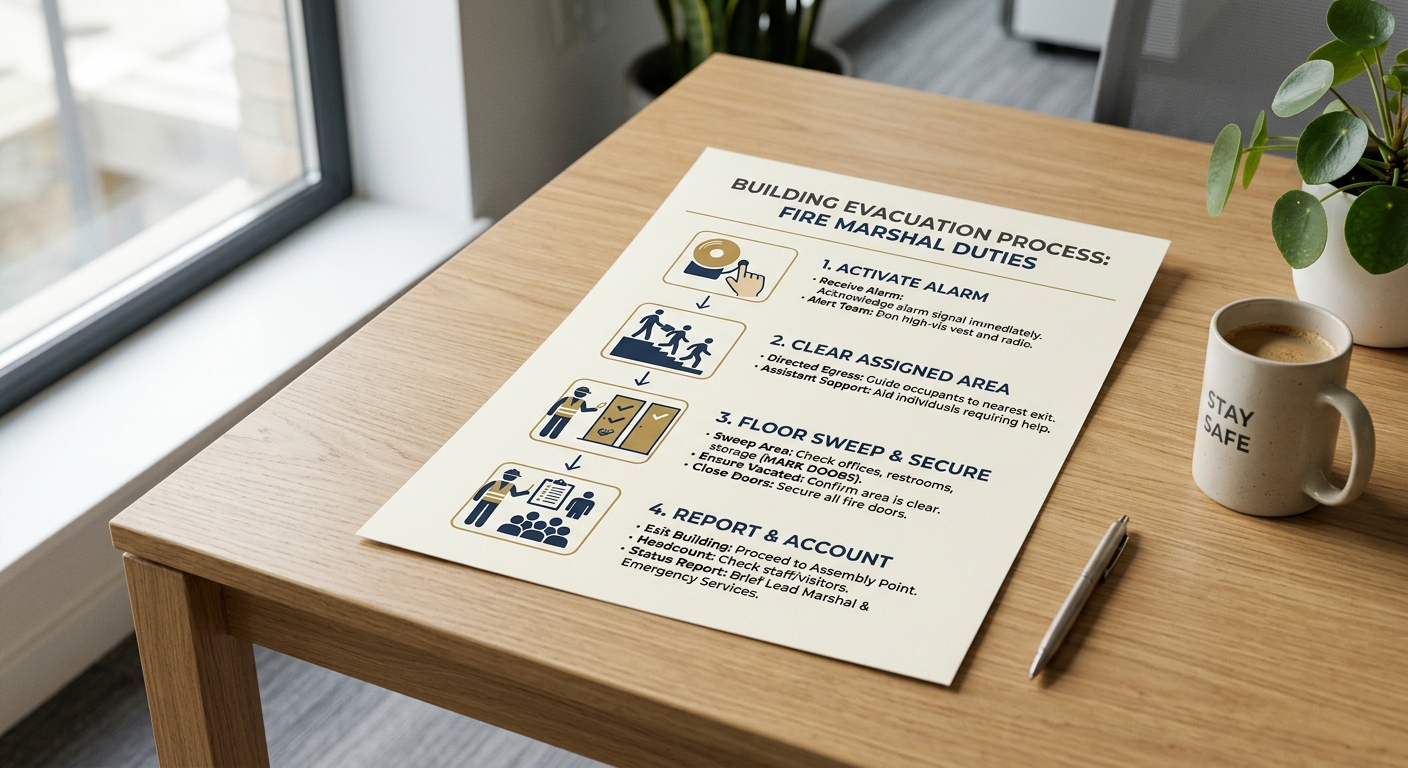
While fire safety assistants focus primarily on fighting initial fires using hand-held extinguishers and managing immediate hazards under ASR A2.2 and DGUV Information 205-023, evacuation marshals (Räumungshelfer or Evakuierungshelfer) concentrate entirely on life safety, zoning checks, and personnel tracking. Their core mandate, guided by DGUV Information 205-033, is the swift, calm, and orderly clearing of buildings during an emergency. By acting as calm authorities, they prevent panic and ensure that all occupants, including visitors and individuals with limited mobility, safely reach designated assembly points.
Legal Basis and Designation Requirements
Under Section 10 of the German Occupational Health and Safety Act (Arbeitsschutzgesetz - ArbSchG) and ASR A2.2, employers in Germany are legally required to appoint designated employees responsible for emergency evacuation and fire safety. Unlike fire safety assistants, who typically must comprise at least 5% of the workforce, there is no fixed minimum percentage for evacuation marshals. Instead, the precise number of marshals must be determined through a workplace-specific risk assessment (Gefährdungsbeurteilung). Employers must formally appoint these individuals in writing. These roles are typically managed alongside a fire safety officer to coordinate organizational precautions and regular drills. To maintain audit readiness and ensure that every zone has an active warden, compliance officers increasingly utilize the CIVAC Workspace to centralize appointments, track roles, and monitor status.
Core Duties in Everyday Work and Emergency Situations
The responsibilities of an evacuation marshal are divided into ongoing preventive tasks during daily business operations and active operational coordination during a building evacuation. In their daily routine, they monitor escape routes to ensure they remain clear of obstructions and verify that exit doors are unlocked. When an emergency alarm sounds, their duties shift to critical on-the-scene coordination to ensure no one is left behind[4].
| Operational Phase | Core Responsibilities under DGUV Information 205-033 |
|---|---|
| Daily Operations | Inspecting escape and rescue routes to keep them clear of obstructions; checking emergency exits and doors; assisting in organizing regular evacuation drills; training staff on basic evacuation procedures. |
| Emergency Activation | Initiating zone-by-zone clearing of assigned floors; guiding employees and visitors toward designated rescue paths; checking restrooms, conference rooms, and quiet zones; preventing the use of elevators. |
| Post-Evacuation | Escorting people safely to the designated assembly point; checking attendance against current rosters; reporting the clearing status and any missing or trapped persons to emergency response leaders. |
Training, Qualification, and Liability Risks
To legally serve as an evacuation marshal, employees must complete a structured training course based on DGUV Information 205-033. This curriculum focuses on escape route planning, emergency psychology, methods for assisting disabled or injured individuals, and communication protocols during a crisis. Unlike fire safety assistants, there is usually no mandatory physical firefighting practice required for pure evacuation marshals, though combined training courses are common. Managing directors and safety leads must ensure this training is refreshed regularly, typically every two to three years[4]. Failing to designate, train, or document these officers adequately can lead to substantial administrative fines under German occupational health and safety law. Furthermore, in the event of an unorganized evacuation resulting in injury, corporate leaders face personal civil liability and potential criminal prosecution for negligent bodily harm.
Evacuation Marshals at a Glance
- Legal foundation: Mandated under Section 10 of the German Occupational Health and Safety Act (ArbSchG), ASR A2.2, and detailed in DGUV Information 205-033.
- Operational focus: Non-firefighting activities including rapid zone clearing, routing, passenger support, and assembly point checks.
- Staffing ratio: Determined on a case-by-case basis through a formal corporate risk assessment, ensuring all floors and shifts are covered.
- Required qualification: Theoretical and practical training covering evacuation organization, exit routing, crowd control, and assistance methods.
- Compliance documentation: Formal written appointments and training certificates must be recorded in an audit-proof system to shield leadership from liability.
Liability, Fines, and Audit-Proof Documentation for Corporate Officers
Managing directors, compliance officers, and HSE leads in German operations face strict regulatory exposure regarding occupational health and safety. Under the German Occupational Safety Act (Arbeitsschutzgesetz - ArbSchG), employers are legally obligated to implement appropriate fire safety measures, which includes appointing a sufficient number of trained fire safety assistants (Brandschutzhelfer). Failing to comply with these regulations or ignoring official enforcement orders is treated as an administrative offense (Ordnungswidrigkeit). According to § 25 ArbSchG, such violations can result in administrative fines of up to 30,000 EUR for the company[5]. If a lack of fire safety organization leads to an actual fire incident causing injury or death, the company management can face personal criminal prosecution under § 26 ArbSchG, carrying penalties of up to one year in prison or severe personal fines[6].
Beyond direct administrative fines, personal liability is a critical risk factor under German law. According to § 130 of the Act on Regulatory Offenses (Ordnungswidrigkeitengesetz - OWiG), managing directors can be fined personally for breaching their mandatory supervisory duties (Verletzung der Aufsichtspflicht). In the event of a fire, commercial property and liability insurers often audit the company's compliance logs. If an investigation reveals that the legally required number of fire safety assistants was not appointed, or that mandatory fire safety training was neglected, insurers may reject damage claims or seek direct financial recourse against the company directors. Therefore, maintaining detailed, written records is not merely an administrative exercise, but a vital liability shield for company executives and HSE leaders.
Steps to Establish Legally Robust Documentation
To ensure complete liability protection, companies must maintain an audit-proof compliance file. Verbal appointments or simple Excel sheets are insufficient when regulatory bodies, such as the German Trade Licensing Office (Gewerbeaufsichtsamt) or the statutory accident insurance institutions (Berufsgenossenschaften), conduct an audit. Written, structured documentation is required to prove that the company has fully met its duties of care and supervision under ASR A2.2. Utilizing a centralized digital workspace can streamline this tracking, ensuring that no training intervals or appointment certificates are lost.
- Signed appointment certificates (Bestellungsurkunden) detailing the specific roles, duties, and assigned organizational areas for each fire safety assistant and evacuation marshal.
- Legally valid training certificates (Schulungsnachweise) proving that appointed staff have completed both the theoretical instruction and the mandatory practical fire-extinguishing exercises under DGUV Information 205-023.
- Records of recurring instructions and refreshers, confirming that training has been updated within the required three-to-five-year cycle.
- A current, visible list of all active fire safety personnel posted on company bulletin boards or maintained securely within a central digital system.
| Compliance Metric | Audit-Proof Documentation | Informal or Missing Records |
|---|---|---|
| Regulatory Audits | Immediate, frictionless proof of compliance that prevents administrative warnings or fines | High risk of official complaints, regulatory sanctions, and fines up to 30,000 EUR |
| Insurance and Recourse | Secure liability coverage with no grounds for insurers to claim gross negligence | Risk of denied claims, reduced payouts, or direct recourse against managing directors |
| Director Liability (OWiG) | Effective legal exculpation (Haftungsentlastung) by proving active supervisory diligence | Personal liability exposure for managers due to organizational failure and negligence |
Implementing these steps manually across multiple offices or entities creates significant administrative overhead and increases the risk of human error. Neglecting a single training expiration can expose the entire management team to unnecessary liability. Companies can eliminate these risks by utilizing automated platforms like CIVAC, which centralizes task tracking, manages mandatory training schedules, and generates audit-ready compliance histories for all corporate officer roles, including the designated fire safety officer.
Streamlining Fire Safety Compliance with CIVAC
Ensuring complete alignment with German occupational safety regulations like ASR A2.2 requires systematic oversight, continuous tracking, and impeccable record-keeping[7]. For managing directors, HSE leads, and internal compliance officers, the challenge lies not only in designating the correct number of fire safety assistants and evacuation marshals but also in keeping their training up to date and maintaining audit-proof documentation. This is where CIVAC provides a comprehensive compliance ecosystem to alleviate administrative burdens and mitigate liability exposure.
Centralized Management with CIVAC Workspace
The digital compliance platform, the CIVAC Workspace, serves as a centralized hub designed to simplify the coordination of internal company officers and safety roles. This platform enables users to track training intervals, manage formal appointment certificates, and distribute mandatory instructions seamlessly. For instance, employers can easily schedule and log the required annual fire safety training to ensure all designated employees complete their practical exercises and theoretical instruction. By archiving these records in a central interface, the system helps companies maintain an audit-proof documentation trail that can be presented instantly during regulatory inspections.
Professional Support with CIVAC Externe Beauftragte
While the five percent quota of fire safety assistants must consist of internal staff members who are physically present on site, managing their training, organization, and compliance strategy demands specialized expertise. Through CIVAC compliance services, organizations can choose to utilize the service model CIVAC Externe Beauftragte to appoint an external fire safety officer to oversee the entire corporate fire safety structure. This certified specialist can guide internal assistants, draft legally compliant evacuation concepts, conduct risk assessments, and organize the necessary practical drills, ensuring the organization meets all statutory guidelines under DGUV Information 205-023 without straining internal resources.
The table below highlights how organizations can utilize these two solutions to establish a robust, compliant fire safety infrastructure that satisfies German statutory requirements.
| Compliance Dimension | CIVAC Workspace | CIVAC Externe Beauftragte |
|---|---|---|
| Primary Purpose | SaaS platform for managing tasks, appointment logs, and training schedules of internal compliance roles. | Managed compliance service providing external, officially appointed legal officers. |
| Fire Safety Utility | Automating reminders for annual refreshers, managing training certificates, and digital archiving. | Providing an external fire safety officer to train internal assistants and structure safety protocols. |
| Documentation Standard | Generates centralized, audit-proof records of all training and statutory appointments. | Delivers professional, legally compliant risk assessments and customized fire safety concepts. |
Frequently Asked Questions
What is the legal basis for appointing fire safety assistants in Germany?
The primary legal basis is Section 10 of the German Occupational Health and Safety Act (Arbeitsschutzgesetz - ArbSchG) in conjunction with Workplace Directive ASR A2.2. These regulations mandate that employers take appropriate measures for firefighting and evacuation, including appointing a sufficient number of qualified employees to perform these duties.
How many fire safety assistants does a company need to appoint?
According to Technical Rule ASR A2.2, a ratio of 5% of the active workforce is generally sufficient for operations classified under normal fire hazards, such as standard office environments. For businesses with increased fire risks or complex layouts, a detailed risk assessment is required, which often necessitates a higher percentage of trained staff.
What training is required for a fire safety assistant (Brandschutzhelfer)?
Under DGUV Information 205-023, the training must consist of both theoretical and practical components. The theoretical instruction must cover at least 2 teaching units of 45 minutes each, detailing fire behavior and emergency procedures. The practical training must feature hands-on extinguishing drills with real fire simulators.
What is the difference between a fire safety assistant and an evacuation marshal?
While fire safety assistants (Brandschutzhelfer) focus primarily on fighting initial fires and preventative measures, evacuation marshals (Räumungshelfer) are responsible for coordinating the orderly evacuation of buildings, checking designated zones, and securing the assembly point during emergencies.
How often must fire safety and evacuation training be refreshed?
To maintain active compliance, regular refresher training is strongly recommended every 3 to 5 years under DGUV Information 205-023. However, if there are significant changes to the workplace, such as structural modifications, new fire hazards, or high staff turnover, refresher courses must be conducted sooner.
What are the penalties for failing to appoint these fire safety officers?
Failing to appoint, train, and document fire safety assistants and evacuation marshals constitutes a regulatory offense. Under the Arbeitsschutzgesetz, managing directors can face administrative fines of up to 30,000 EUR. Furthermore, in the event of an actual fire, lack of compliance can lead to severe personal liability and loss of insurance coverage.
Sounds like a lot of work?
Officer duties, deadlines, paperwork — that's exactly what we take off your hands. Say hello and we'll show you how.
The officer role behind this article
Sources
- publikationen.dguv.de
- prosafecon.de
- publikationen.dguv.de
- beauftragter-online.de
- drweb.de
- sicherheitsingenieur.nrw
- dgwz.de
- CIVAC - Wir übernehmen Compliance
- Leistungen von CIVAC
- Jährliche Brandschutzunterweisung: Pflichten, Inhalte, Nachweise 2026
- Brandschutzbeauftragter bestellen: Pflicht, Qualifikation und Audit-Spur
- Die CIVAC Compliance-Plattform
- Brandschutzbeauftragter bestellen: Pflicht, Kosten und Konzept
Turn this into a mandate.
Let us carry the operational weight. External officer, templates and documentation in one workspace. No obligation.

Sections 6, 17, 45 ElektroG: registration before placing on the market, take-back from 400 square metres, fines up to EUR 100,000