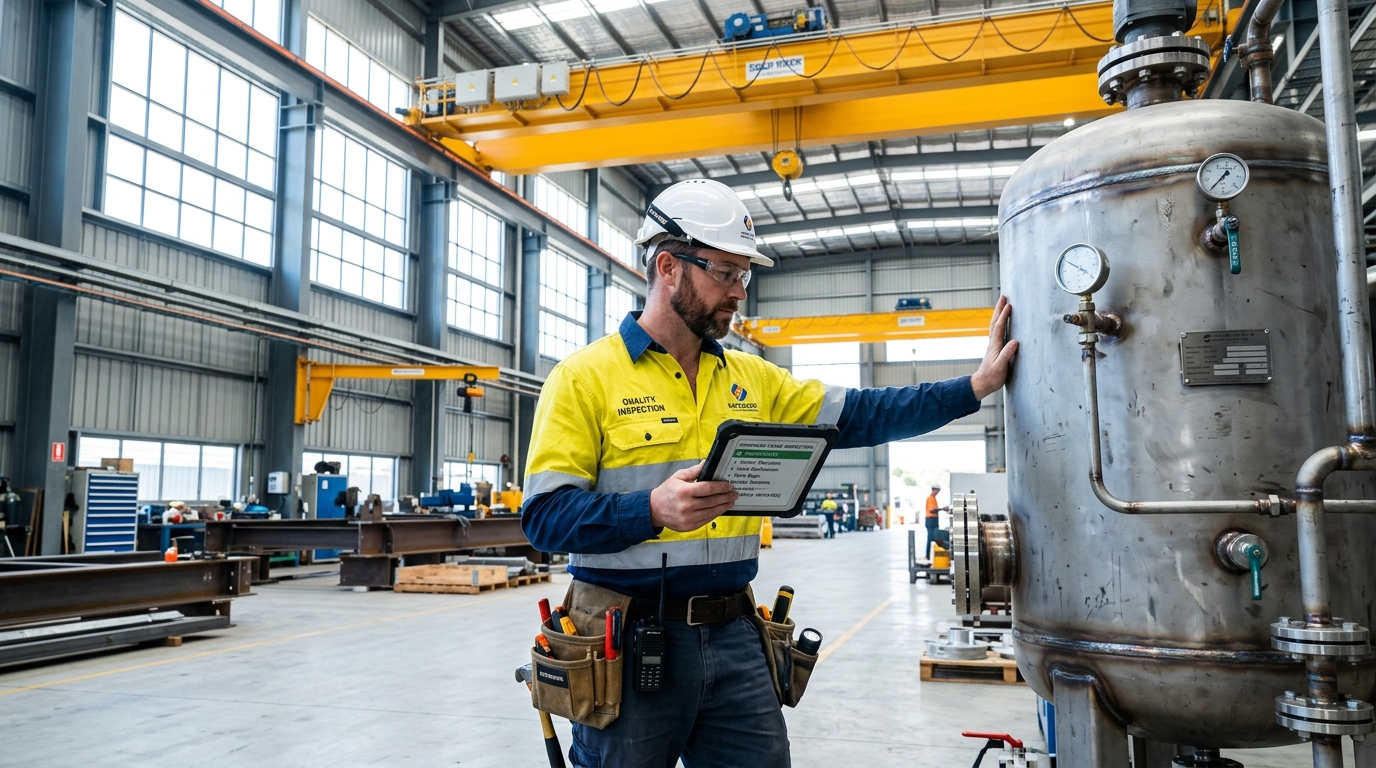
Competent Person for Inspecting Cranes, Pressure Equipment and Lifts
Discover the legal duties, training rules, and liability risks for appointing a Competent Person for cranes, lifts and pressure equipment under BetrSichV.
Key Takeaways
- Cranes and lifting equipment require at least 1 annual inspection by a competent person under DGUV Regulation 52.
- Hydraulic hose lines must be regularly assessed and replaced in strict compliance with DGUV Rule 113-020.
- A competent person under TRBS 1203 must have relevant vocational training and up-to-date technical knowledge.
- Pressure equipment and lifts require coordination between internal competent persons and a certified ZÜS body.
The Legal Mandate for Equipment Inspections
In Germany, the operational safety of industrial equipment is governed by a strict statutory framework designed to prevent accidents and protect employees. At the heart of this framework sits the German Industrial Safety Regulation (Betriebssicherheitsverordnung or BetrSichV), which mandates that employers must ensure all work equipment is safe to use. According to § 3 of the BetrSichV, companies are legally required to conduct a thorough risk assessment (Gefährdungsbeurteilung) before deploying any machinery. A core outcome of this assessment is determining the nature, scope, and specific deadlines for necessary technical inspections, which must be performed exclusively by qualified experts known as a 'competent person' or zur Prüfung befähigte Person. As part of structured corporate governance, a dedicated compliance officer or HSE lead must oversee these processes to ensure that all operational guidelines are met systematically.
Understanding the Role of the Competent Person (TRBS 1203)
The concrete requirements for these inspectors are defined under the Technical Rules for Operational Safety (Technische Regeln für Betriebssicherheit - TRBS 1203). To legally inspect high-risk equipment such as cranes, pressure systems, and lifts, an individual must fulfill a strict triad of qualifications. First, they must have completed relevant vocational training or university education in a technical field. Second, they must possess professional experience working with the equipment in question. Finally, they must maintain recent professional activity (zeitnahe berufliche Tätigkeit) in the field, which includes performing regular inspections and participating in continuous professional development to stay up to date with technological advancements and evolving safety standards[1].
Management Liability and Personal Responsibility
For managing directors, HSE managers, and compliance leads, neglecting these inspection obligations carries severe legal and financial risks. Under German law, failure to appoint a qualified competent person or failing to carry out regular inspections constitutes a regulatory offense (Ordnungswidrigkeit) under § 22 BetrSichV, which can result in substantial administrative fines. If an accident occurs and negligence is proven, the liability escalates to criminal exposure (Straftat) under § 23 BetrSichV or the German Criminal Code (StGB) for bodily harm caused by negligence. To mitigate these personal liability risks, executives must establish an audit-proof system of appointment, task delegation, and compliance documentation. Structured systems such as the CIVAC platform help management and safety officers track deadlines, store official appointment certificates, and document inspections in a legally sound manner.
Core Obligations at a Glance
- Conducting a comprehensive risk assessment (Gefährdungsbeurteilung) to define the frequency and scope of technical inspections.
- Appointing qualified competent persons (zur Prüfung befähigte Personen) who meet the technical training and active-duty criteria of TRBS 1203.
- Ensuring regular inspection intervals, typically at least once a year, for high-risk systems like cranes, pressure vessels, and hydraulic lines.
- Maintaining complete, audit-proof records of all inspection reports, defects found, and corrective actions taken.
Competent Person for Cranes (DGUV Rule 52 and 54)
In Germany, cranes and hoisting equipment represent high-risk industrial assets subject to strict regular inspection mandates. Under the accident prevention regulations of the German Social Accident Insurance (DGUV), specifically DGUV Regulation 52 (DGUV Vorschrift 52) for cranes and DGUV Regulation 54 (DGUV Vorschrift 54) for winches, lifting, and pulling devices, employers must guarantee that these systems are safe. According to Section 26 of DGUV Regulation 52, cranes must be inspected by a competent person (known in German as a zur Prüfung befähigte Person or Sachkundiger) before initial commissioning and at least once a year thereafter[2]. This requirement is further anchored in Section 14 of the German Industrial Safety Regulation (Betriebssicherheitsverordnung or BetrSichV), which specifies the general inspection intervals and duties for industrial work equipment.
Key Duties and Inspection Scope
The primary duty of the competent person for cranes is to perform the legally mandated annual recurring inspections. This process involves a comprehensive physical and functional check of the entire installation. The inspector must verify the condition of load-bearing structures, ropes, chains, hooks, safety devices, brakes, and limit switches to detect wear, corrosion, or deformation. Beyond the regular annual cycle, the competent person is also responsible for extraordinary inspections. These are required following major modifications, repairs, structural changes, or exceptional occurrences such as collisions or overloads, before the crane is allowed to resume operation. All results, identified defects, and repairs must be documented in a dedicated crane inspection logbook (Prüfbuch).
Professional Qualifications and Training
An employer cannot simply appoint any employee to inspect complex lifting equipment. The Technical Rules for Operational Safety (TRBS 1203) define the strict qualifications required to act as a competent person[1]. The individual must possess a completed technical education (such as an engineering degree, master craftsman certificate, or technical vocational training in mechanical or electrical engineering). Additionally, they must have relevant professional experience working with cranes, a deep familiarity with the applicable safety rules, and up-to-date technical knowledge maintained through regular training courses. Keeping track of these credentials, organizing annual training schedules, and ensuring the formal written appointment is completed can be managed efficiently using the digital workflow tools in the CIVAC Workspace.
Liability and Fine Exposure
Failing to comply with German crane inspection regulations carries severe financial and legal consequences for corporate officers. Under the BetrSichV and the German Act on Regulatory Offences (OWiG), neglecting mandatory inspections or failing to appoint a qualified competent person is classified as a regulatory infraction. Employers can face administrative fines of up to EUR 30,000 per violation. In the unfortunate event of a workplace accident involving personal injury or death due to faulty lifting gear, directors and HSE managers face personal criminal liability under the German Criminal Code (StGB) for negligent bodily harm or manslaughter. Furthermore, commercial insurance providers frequently reject coverage claims if the required inspection logs are missing or incomplete. Organizations can mitigate these compliance risks by establishing strong corporate oversight under a dedicated compliance officer.
- Legal Basis: Section 26 of DGUV Regulation 52, Section 23 of DGUV Regulation 54, and Section 14 of the Betriebssicherheitsverordnung (BetrSichV).
- Inspection Frequency: Mandatory pre-commissioning inspection, recurring inspections at least once a year, and extraordinary testing after modifications.
- Required Qualification: Technical vocational or academic degree, hands-on experience with cranes, and active continuous training per TRBS 1203 standards.
- Documentation Obligation: Complete and audit-proof recording of all inspection steps, defects, and repairs in the crane's official testing book (Prüfbuch).
- Non-Compliance Risks: Administrative fines up to EUR 30,000, personal criminal liability for negligent injury, and loss of commercial insurance protection.
Competent Person for Hydraulic Hoses (DGUV 113-020)
Hydraulic hose lines are critical safety components in industrial machinery and mobile equipment. Operating under extreme pressure, a sudden rupture or failure can lead to severe operational disruptions, environmental hazards, and catastrophic workplace injuries. Under the German Industrial Safety Regulation (Betriebssicherheitsverordnung - BetrSichV), employers are legally obligated to ensure that these pressurized components are regularly inspected. To guide companies in meeting these strict compliance standards, the German Social Accident Insurance publishes DGUV Rule 113-020 (formerly BGR 237), which defines the framework for safe usage and dictates the mandatory involvement of a qualified competent person (befaehigte Person) for the inspection of hydraulic hose lines.
Legal Basis and Assessment of Wear and Tear
The primary objective of DGUV Rule 113-020 is to preemptively identify degradation in hydraulic hoses before a hazardous malfunction occurs[3]. The appointed competent person must perform regular visual and functional inspections. Key indicators of wear and tear that require immediate replacement include external damage to the outer layer, visible cracks, severe abrasion, kinked or twisted sections, and any signs of deformation or swelling under pressure. Furthermore, corrosion of the metal fittings or leakage at the connection points signals a high-risk failure that demands taking the machinery out of service until proper repairs are conducted.
Standard Replacement Cycles and Storage Limits
A fundamental aspect of managing pressurized hydraulic equipment is adhering to strict replacement cycles. According to DGUV Rule 113-020, hydraulic hose lines have a naturally limited lifespan due to chemical aging and continuous physical stress. For standard industrial applications, the established safety guideline dictates a maximum useful life of six years, which includes a maximum storage period of two years prior to installation[4]. For high-load machinery or extreme environmental conditions, the required risk assessment (Gefaehrdungsbeurteilung) may dictate even shorter replacement intervals to protect operators and remain legally compliant.
Appointment, Qualification, and Documentation Requirements
To perform these mandatory technical checks, the employer must formally appoint a qualified competent person in writing. Under Technical Rules for Operational Safety (TRBS 1203), this inspector must possess relevant professional training, hands-on experience with hydraulic systems, and recent active involvement in testing processes. Every single inspection, defect report, and replacement must be documented in an audit-proof register to prevent liability and administrative fines in the event of an accident. Managing these high-frequency inspection logs and scheduling recurring tasks is streamlined through digital systems like the CIVAC Workspace, ensuring all documentation remains centralized and fully audit-ready.
- Legal Framework: German Industrial Safety Regulation (Betriebssicherheitsverordnung) and statutory guidelines under DGUV Rule 113-020.
- Inspection Frequency: Systematic visual and functional checks conducted at least once a year by an authorized inspector.
- Lifespan Limits: Standard replacement interval of six years, containing a maximum pre-installation storage limit of two years.
- Inspector Credentials: Technical background, practical experience with hydraulic systems, and specialized training as defined by TRBS 1203.
- Liability Risk: Inadequate inspection logs or missed replacement cycles expose managing directors to heavy administrative fines and personal liability in case of equipment failure.
Pressure Equipment (BetrSichV and TRBS 1201)
Pressure systems, such as steam boilers, compressed air receivers, and gas storage tanks, carry significant explosive and physical hazards. To safeguard employees and operations, the German Industrial Safety Regulation (Betriebssicherheitsverordnung or BetrSichV) mandates the regular inspection of these systems, referencing the technical guideline TRBS 1201 (Technical Rules for Operational Safety). In Germany, operators must ensure that all systems requiring monitoring are checked both before commission and periodically thereafter by a qualified competent person (zur Prüfung befähigte Person) or an approved inspection body (Zugelassene Überwachungsstelle or ZÜS)[5].
Core Inspection Duties and ZÜS Coordination
Under Annex 2, Section 4 of the BetrSichV, the division of labor between internal competent persons and external ZÜS inspectors depends on the pressure vessel's volume, temperature, and maximum allowable operating pressure. For lower-risk configurations, an internally appointed competent person may carry out the necessary recurring inspections. However, for higher-hazard equipment, the operator must coordinate with an accredited ZÜS, such as TÜV or DEKRA, to perform external, internal, and mechanical integrity tests[6]. The internal competent person remains responsible for preparing the equipment, checking auxiliary safety devices like pressure relief valves, and managing the inspection documentation within the legal logbook. Utilizing digital tracking systems like the CIVAC Workspace ensures that these tightly regulated inspection dates are met on time.
Qualifications Required under TRBS 1203
An operator cannot simply nominate any staff member to inspect high-risk pressure systems. The technical rules under TRBS 1203 set clear and strict requirements. The designated competent person must possess a technical vocational certificate or a specialized engineering degree, have relevant practical experience operating or maintaining comparable pressure systems, and participate in regular continuing education courses. This combination of hands-on expertise and current legal knowledge ensures the inspector can accurately assess risks and notice structural defects like micro-fissures or chemical corrosion. A company's designated compliance officer must meticulously verify and document these prerequisites before assigning the role.
| Inspection Category | Authorized Tester | Focus Area | Standard Interval |
|---|---|---|---|
| External Inspection (Äußere Prüfung) | Competent Person or ZÜS | Visual safety check of outer shell, insulation, and pressure indicators | Up to 2 years |
| Internal Inspection (Innere Prüfung) | Competent Person (low-risk) or ZÜS | Thorough wall inspection, examination of inner coatings, and rust checks | Up to 5 years |
| Strength Test (Festigkeitsprüfung) | Competent Person (low-risk) or ZÜS | Static pressure test to verify the structural integrity of the vessel walls | Up to 10 years |
Liability and Regulatory Fine Exposure
Failing to conduct recurring tests on pressure systems is a direct violation of German occupational safety regulations. If a pressure system operates past its inspection deadline without the required competent person or ZÜS approval, it is classified as an administrative offence. Under the BetrSichV and the German Product Safety Act, regulatory agencies can issue corporate fines of up to 100,000 EUR for non-compliance[7]. More critically, if a mechanical failure or explosion causes injury or severe property damage, managing directors and HSE officers face personal criminal prosecution for negligent bodily harm and public endangerment.
- Legal Mandate: Guided by BetrSichV Annex 2 Section 4 and TRBS 1201 guidelines
- Competency Standards: Strict requirements under TRBS 1203 including formal technical education and proven practical experience
- Scope of Inspections: Encompasses regular external, internal, and mechanical strength testing of all pressurized components
- ZÜS Coordination: Mandated external involvement for high-pressure installations and steam-generating boilers
- Regulatory Risk: Heavy fines up to 100,000 EUR and direct personal criminal exposure for safety omissions
Lift Installations and ZÜS Main Inspections
Under Section 16 of the German Ordinance on Industrial Safety and Health (Betriebssicherheitsverordnung - BetrSichV), passenger and goods lift installations are classified as high-risk systems requiring strict supervision (überwachungsbedürftige Anlagen)[8]. This classification mandates that operators (Betreiber) cannot inspect these systems independently but must delegate recurring inspections to an Approved Inspection Body (Zugelassene Überwachungsstelle - ZÜS) such as TÜV or DEKRA. The legal framework establishes a strict dual-inspection cycle, alternating between a comprehensive main inspection (Hauptprüfung) and an intermediate inspection (Zwischenprüfung), ensuring that lifts undergo independent technical audits annually[9].
The Appointed Person for Lift Installations
While the ZÜS performs the official statutory inspections, the operator is legally responsible for the daily operational safety of the lift installation under TRBS 3121[10]. This requirement is met by designating an Appointed Person for Lift Installations (beauftragte Person für Aufzugsanlagen, formerly colloquially known as the Aufzugswärter). This officer acts as the first line of defense, conducting regular visual and functional checks, monitoring the emergency call system, and initiating emergency rescue protocols (Personenbefreiung) in the event that passengers become trapped. To perform these duties safely and legally, this corporate representative must undergo documented specialized safety instruction[11].
Preparing for the ZÜS Audit and Routine Operations
Preparing for a biennial ZÜS main inspection is a rigorous process that requires compiling complete, audit-proof technical documentation. Before the ZÜS expert arrives on site, the Appointed Person must ensure that all safety devices are functional, escape routes are clear, and the emergency communication system is fully operational. Systematically organizing these preparation workflows helps companies prevent unexpected operational shutdowns or regulatory penalties. For instance, organizing documentation and ensuring seamless compliance is simplified with digital audit preparation tools, enabling teams to aggregate technical manuals, manufacturer specifications, and previous inspection reports in one accessible place.
Maintaining the Lift Logbook
A cornerstone of operational compliance is the meticulous maintenance of the lift logbook (Aufzugsbuch). According to TRBS 1201 Part 4, every test, routine visual check, maintenance interval, and ZÜS inspection certificate must be recorded chronologically in this logbook[12]. Missing, incomplete, or falsified entries expose managing directors and compliance officers to substantial liability and severe administrative fines in the event of an accident or regulatory audit. To streamline this overhead, companies can implement the CIVAC Workspace to manage recurring safety tasks, assign specific inspection checklists, and maintain a digitally archived, audit-proof log of all compliance achievements.
- Legal basis: Section 16 of the German Ordinance on Industrial Safety and Health (BetrSichV), TRBS 3121, and TRBS 1201 Part 4.
- Mandatory inspections: Dual-cycle alternating main inspections (Hauptprüfung) and intermediate inspections (Zwischenprüfung) conducted annually by a ZÜS.
- Operational appointments: Written appointment of an Appointed Person (formerly Aufzugswärter) trained in safety operations and emergency passenger rescue.
- Emergency communication: Active 2-way emergency communication system connected to a 24/7 monitored emergency service.
- Documentation duty: Maintenance of an up-to-date, chronologically organized lift logbook (Aufzugsbuch) containing all inspection records and defect logs.
How CIVAC Ensures Audit-Proof Compliance
Managing industrial operations with high-risk machinery such as cranes, pressure equipment, and lift installations requires absolute precision. Under the German Ordinance on Industrial Safety and Health (Betriebssicherheitsverordnung, or BetrSichV), managing directors and occupational safety specialists face strict personal liability for ensuring that every piece of equipment is regularly inspected by a competent person. Neglecting these intervals or failing to present audit-proof records during an official inspection can lead to severe fines, operational shutdowns, and even personal criminal liability. To bridge the gap between complex legal requirements and daily operational workflows, CIVAC provides a robust compliance ecosystem that centralizes documentation and streamlines the appointment of qualified safety officers.
Centralizing Industrial Safety Documentation
The core of this ecosystem is the CIVAC Workspace, a comprehensive compliance SaaS platform designed to streamline corporate compliance roles and high-risk equipment inspections. According to Section 14 paragraph 7 of the BetrSichV, employers must record the results of all inspections and keep them at least until the next scheduled test, while Section 17 mandates that records for installations requiring monitoring must be preserved at the operating site for their entire service life[13]. The platform solves this administrative burden by providing a centralized, secure digital repository. Here, internal compliance officers, HSE leads, and functional managers can track scheduled inspections, store ZÜS certificates, and compile audit-proof records. This continuous data collection ensures seamless audit preparation, making it easy to present required documentation during regulatory inspections.
| Equipment Type | Legal & Technical Basis | Documentation Requirement | CIVAC Solution |
|---|---|---|---|
| Cranes and Lifting Systems | DGUV Rule 52 and 54, TRBS 1203 | Annual inspection records kept at least until the next scheduled test | Automated recurring task scheduling and custom digital templates in the Workspace |
| Pressure Equipment | BetrSichV, TRBS 1201 | Certificates for systems requiring monitoring kept for their entire service life | Centralized secure cloud repository with automated expiration alerts for ZÜS intervals |
| Lift Installations | BetrSichV Section 16 | ZÜS main and intermediate inspection protocols stored directly at the operational site | Instant mobile-friendly access to all certified documents during onsite safety inspections |
Legally Mandating External Experts
For many organizations, sourcing, training, and maintaining in-house competent persons for every specialized safety role is a significant operational strain. This is where CIVAC Externe Beauftragte offers a legally secure, hassle-free alternative. By leveraging these managed compliance services, companies can legally appoint certified, external safety officers who take over the official role of the competent person. This not only ensures that inspections are carried out by highly qualified specialists in compliance with the latest regulations, but also significantly reduces the operational and administrative burden on internal teams. Managing directors can delegate these critical functions with confidence, knowing that all appointment certificates, task reports, and liability documentations are maintained transparently and securely within the digital workspace.
Frequently Asked Questions
What defines a competent person under TRBS 1203?
A competent person under TRBS 1203 must possess relevant vocational training, recent professional experience, and up-to-date technical knowledge to reliably inspect work equipment and detect safety hazards.
How often must cranes be inspected in Germany?
Under DGUV Regulation 52, cranes, winches, and lifting equipment must be inspected by a qualified expert or competent person at least 1 time per year.
What is the role of a ZÜS for pressure equipment and lifts?
A ZÜS (Zugelassene Überwachungsstelle) is a state-approved inspection body mandated under BetrSichV to conduct independent main inspections of high-risk installations like pressure vessels and lifts.
What are the rules for hydraulic hoses under DGUV 113-020?
DGUV Rule 113-020 requires regular inspections, maintenance, and timely replacement of hydraulic hose lines to prevent fluid leaks and workplace accidents, enforced strictly under BetrSichV.
What are the penalties for missing equipment inspections?
Failing to conduct legally mandated inspections under BetrSichV can result in severe fines and personal liability for managing directors in the event of an accident.
Can a company outsource the competent person role?
Yes, companies can use managed services like CIVAC Externe Beauftragte to legally appoint external experts, ensuring compliance with BetrSichV while shifting the administrative burden away from internal management.
Sounds like a lot of work?
Officer duties, deadlines, paperwork — that's exactly what we take off your hands. Say hello and we'll show you how.
The officer role behind this article
Sources
- baua.de
- bghm.de
- publikationen.dguv.de
- bghm.de
- kopterflug.de
- tuev-hessen.de
- fimro.com
- dekra.de
- tuvsud.com
- vorschriften.bgn-branchenwissen.de
- akademie.tuv.com
- baua.de
- gesetze-im-internet.de
- CIVAC - Wir übernehmen Compliance
- Audit-Vorbereitung mit CIVAC
- Leistungen von CIVAC
- Die CIVAC Compliance-Plattform
- Compliance-Beauftragter: Pflichten, Bestellung, AI Act 2026
Turn this into a mandate.
Let us carry the operational weight. External officer, templates and documentation in one workspace. No obligation.
Sections 6, 17, 45 ElektroG: registration before placing on the market, take-back from 400 square metres, fines up to EUR 100,000