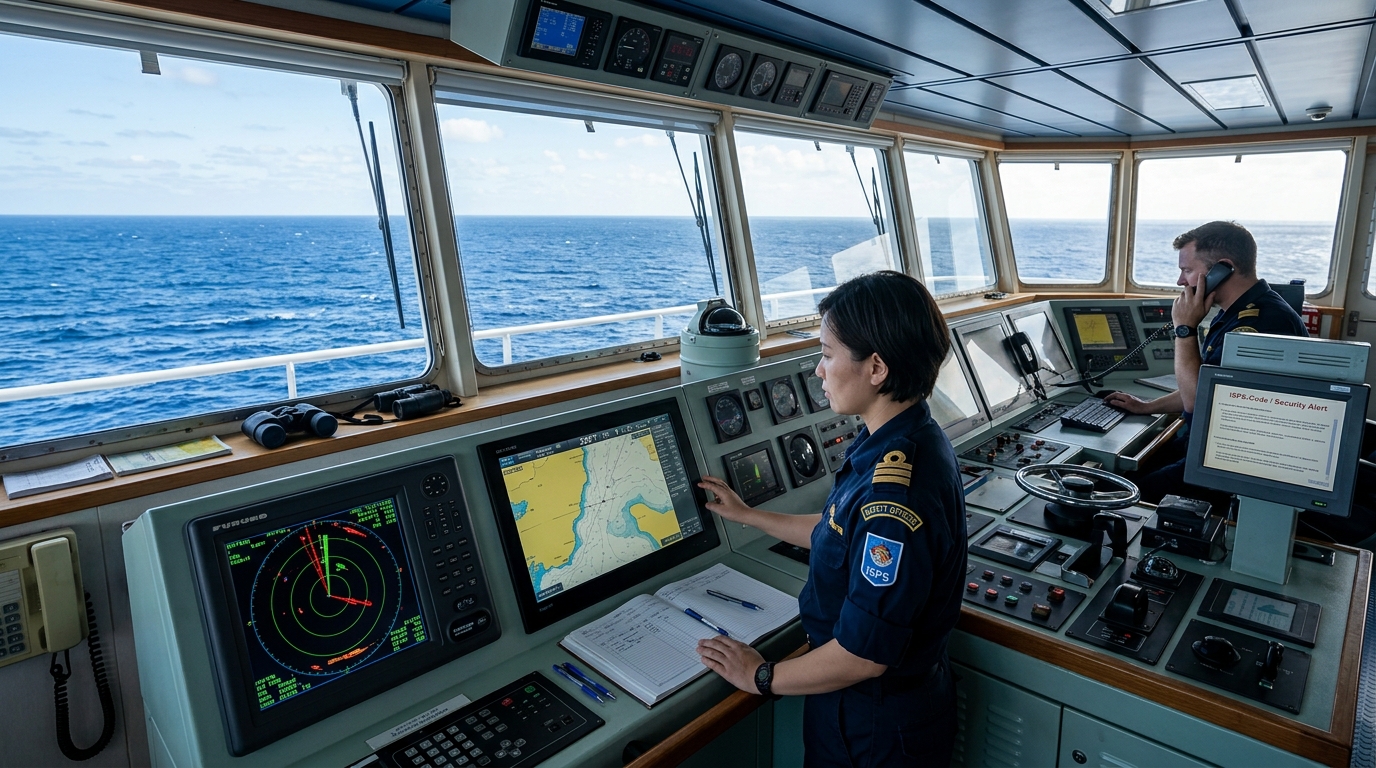
Ship Security Officer and Maritime Security under the ISPS Code
A practical guide to the legal duties, training, and liability of Ship Security Officers (SSO) and Company Security Officers (CSO) under German maritime law.
Key Takeaways
- The ISPS Code applies to passenger ships and cargo vessels of 500 gross tonnage and upwards operating on international voyages.
- The Company Security Officer (CSO) is responsible for the overall security management of the fleet and 24/7 incident response coordination.
- The Ship Security Officer (SSO) manages onboard security, conducts regular ship inspections, and leads mandatory crew security drills.
- German law requires SSOs and CSOs to undergo a strict security clearance under the See-Sicherheitsüberprüfungsgesetz (SeeSÜG).
- Violations of maritime security appointment and training duties can result in corporate fines of up to 50,000 euros under German law.
Introduction to Maritime Security and the ISPS Code
The global maritime industry underwent a profound transformation in the wake of the September 11, 2001, terrorist attacks. To address critical vulnerabilities in international shipping and port infrastructure, the International Maritime Organization developed a comprehensive security regime. Adopted in December 2002 as a crucial amendment to the International Convention for the Safety of Life at Sea, specifically under SOLAS Chapter XI-2, this framework is known as the International Ship and Port Facility Security Code[1]. It establishes a standardized risk management methodology designed to detect security threats and implement preventive measures on vessels and at port facilities worldwide.
Scope and Applicability of the Security Framework
The security requirements of SOLAS Chapter XI-2 and Part A of the ISPS Code apply to specific vessel classes and facilities. Understanding these thresholds is essential for managing directors, corporate compliance officers, and health, safety, and environment leads who manage maritime operations. The international rules target passenger ships, including high-speed passenger craft, as well as cargo ships of 500 gross tonnage and upwards. Additionally, mobile offshore drilling units must adhere to these standards, making compliance critical for modern maritime logistics.
- Establishing an international framework for cooperation in detecting and preventing security threats
- Defining clear roles and responsibilities for contracting governments, shipping companies, and port facilities
- Ensuring the early and efficient collection and exchange of security-related information
- Providing a methodology for security assessments to establish plans and procedures to react to changing security levels
In Germany, these international mandates are codified and enforced through domestic maritime legislation. The primary legal vehicle for vessels is the See-Eigensicherungsverordnung (SeeEigensichV), also known in English as the Ordinance on Shipboard Security Measures. This ordinance governs how German-flagged vessels and international fleets operating in German sovereign waters must implement and monitor their onboard security systems. Compliance is strictly monitored, and failures can result in significant legal and operational penalties for shipowners and companies. To streamline these complex regulatory requirements, many organizations rely on a centralized compliance platform to manage documentation and track mandatory officer appointments.
The Company Security Officer (CSO): Fleet-Wide Security Governance
Under maritime security regulations, the Company Security Officer (CSO) serves as the central hub for compliance, managing the security profiles of an entire fleet from shore. According to Section 11 of Part A of the International Ship and Port Facility Security (ISPS) Code, every shipping company operating vessels under these requirements must designate at least one CSO[2]. In Germany, this international standard is codified under Section 4 of the German Ordinance on Shipboard Security Measures (See-Eigensicherungsverordnung or SeeEigensichV). The CSO represents a critical role for international groups with German operations, bridging the gap between maritime administrative bodies like the Federal Maritime and Hydrographic Agency (BSH) and the crew members on board each vessel.
Core Responsibilities and Operational Duties
The CSO is primarily tasked with establishing, maintaining, and constantly reviewing the security infrastructure for all vessels within their purview. Rather than working solely on individual ships, the CSO takes an overarching fleet perspective, ensuring that security practices are uniform, audited, and strictly aligned with global standards. They are responsible for conducting detailed ship security assessments and utilizing that data to create individual Ship Security Plans (SSPs) that address the specific vulnerabilities of each vessel. Additionally, the CSO acts as the primary contact point for security authorities and must be available around the clock to coordinate responses to security incidents or threat-level modifications.
- Developing and maintaining approved Ship Security Plans (SSPs) tailored to each vessel
- Conducting comprehensive ship security assessments to identify operational vulnerabilities
- Coordinating the implementation of security measures with Ship Security Officers (SSOs) and Port Facility Security Officers (PFSOs)
- Ensuring 24/7 availability for urgent communication and rapid incident response coordination
- Organizing regular security drills, exercises, and internal audits across the fleet to verify plan compliance
To manage these administrative and operational duties effectively, a modern compliance officer can leverage digital tools. The CIVAC Workspace provides structured interfaces to oversee officer assignments, monitor recurring tasks, and document compliance actions in an audit-proof manner. This digital infrastructure is crucial, as German regulatory authorities require precise, chronological records of all security assessments, plan revisions, and drills to verify that the company is meeting its statutory duties under the SeeEigensichV.
The Ship Security Officer (SSO): Onboard Security Operations
The Ship Security Officer (SSO) serves as the primary onboard authority responsible for executing the ship's security measures. Appointed under Section 12 of Part A of the International Ship and Port Facility Security (ISPS) Code and SOLAS Chapter XI-2, the SSO is crucial for vessels flying under the German flag, where the Ordinance on Shipboard Security Measures (See-Eigensicherungsverordnung or SeeEigensichV) defines shipboard security obligations[3]. The managing directors and internal compliance officers of German maritime groups must ensure these appointments are executed flawlessly to guarantee seaworthiness and legal compliance.
Core Duties and Daily Onboard Operations
Under ISPS Code Part A, Section 12.2, the SSO's responsibilities encompass both proactive security monitoring and rapid incident response[4]. Daily tasks are highly structured, requiring meticulous documentation and clear communication channels. The SSO is the primary liaison on board for executing regular security inspections of the ship to ensure that appropriate security measures are continuously maintained in accordance with the Ship Security Plan (SSP). Additionally, the SSO manages the vessel's official security log, documenting all security incidents, training sessions, and drill results, which must remain audit-ready for inspection by flag state authorities like Germany's Federal Maritime and Hydrographic Agency (Bundesamt für Seeschifffahrt und Hydrographie or BSH).
- Regular Security Inspections: Conducting continuous physical audits of the vessel's restricted areas, deck access points, and hull integrity to prevent unauthorized access.
- Security Log Maintenance: Keeping an accurate, time-stamped record of all security-related events, equipment calibrations, and access control actions on board.
- Crew Training and Drills: Planning and executing mandatory security drills (such as anti-piracy and intruder response) at least once every three months, or as mandated by SOLAS guidelines.
- Equipment Verification: Ensuring that onboard security systems, including CCTV, alarms, and communication networks, are fully functional, calibrated, and maintained.
- Coordination with PFSOs: Cooperating directly with Port Facility Security Officers (PFSOs) during port calls to ensure seamless handovers of security responsibilities and cargo operations.
Coordination with external stakeholders is a critical facet of the SSO's role. For instance, when a vessel docks, the SSO must align onboard security levels with those of the port, collaborating with the local Port Facility Security Officer (PFSO) to manage cargo handling, ship stores delivery, and crew embarkation safely[4]. Any deficiencies in the ship's security infrastructure or protocols must be documented and immediately reported to the Company Security Officer (CSO) to trigger corrective actions and potential amendments to the Ship Security Plan. In the broader context of organizational governance, such rigorous tracking is increasingly managed through digital compliance systems, ensuring that even remote maritime operations align with the standards expected of an onshore compliance officer overseeing corporate risk.
Qualifications, Training, and Security Clearance under German Law
Appointing a Ship Security Officer (SSO) or Company Security Officer (CSO) under German jurisdiction is subject to strict, federally regulated qualification and screening procedures. German maritime security legislation demands that candidates not only possess nautical or corporate expertise but also complete training approved by the Federal Maritime and Hydrographic Agency (Bundesamt fuer Seeschifffahrt und Hydrographie, BSH) in compliance with the STCW Convention. This ensures a uniform standard of maritime defense across all German-flagged fleets and shipping operations.
STCW-Compliant Training and BSH Certification
Under the International Convention on Standards of Training, Certification and Watchkeeping for Seafarers (STCW), specifically Section A-VI/5 of the STCW Code, any designated Ship Security Officer must complete a certified training course[5]. In Germany, these courses must be officially recognized and certified by the BSH. The training covers key areas such as ship security assessments, the development and implementation of Ship Security Plans (SSPs), methods for conducting physical inspections, and crowd management techniques. For the Company Security Officer (CSO), the training focuses on coordinating fleet-wide security, liaising with government agencies, and managing crisis communication, also aligned with the BSH guidelines and the International Ship and Port Facility Security (ISPS) Code.
| Requirement Category | Ship Security Officer (SSO) | Company Security Officer (CSO) |
|---|---|---|
| Primary Legal Basis | STCW Regulation VI/5, SOLAS Chapter XI-2, German Maritime Security Act (See-Sicherheitsgesetz) | ISPS Code Part A/11, German Maritime Security Act (See-Sicherheitsgesetz) |
| Mandatory Training | BSH-approved STCW SSO training course with certificate of proficiency | BSH-compliant CSO security course covering fleet-wide risk management |
| German Security Clearance | Required under the See-Sicherheitsueberpruefungsgesetz (SeeSUEG) | Required under the See-Sicherheitsueberpruefungsgesetz (SeeSUEG) |
Security Clearance under the SeeSUEG
Beyond technical and nautical training, German maritime security legislation imposes a strict personal screening requirement for safety-sensitive roles. Under the German Maritime Security Screening Act (See-Sicherheitsueberpruefungsgesetz, SeeSUEG), both SSOs and CSOs must undergo a formal security clearance (Sicherheitsueberpruefung). This vetting process, administered by the BSH in cooperation with federal security authorities, is designed to exclude individuals who pose a potential threat to maritime safety, preventing sabotage, espionage, or terrorist infiltration on German vessels. Candidates must submit comprehensive personal history disclosures, and the clearance must be successfully completed and documented before an officer can legally assume their duties.
Managing these training verification workflows, renewal timelines, and security clearance records is a complex task. For international shipping lines with German operations and local maritime firms, utilizing a structured compliance platform simplifies the tracking of certificate expiries and ensures that all documentation remains audit-proof and readily accessible during BSH inspections. This digital support is particularly valuable for internal compliance officers who must oversee multiple corporate appointments and maintain regulatory standards across various maritime and land-based operations.
Legal Liability, Fines, and Corporate Risk Management
Maritime security compliance is a strict legal mandate under German law, leaving zero room for organizational negligence. Managing directors, compliance directors, and Health, Safety, and Environment (HSE) leads of companies operating under the German flag or running operations in German ports must understand that failing to implement the International Ship and Port Facility Security (ISPS) Code is not just an operational gap, but a profound regulatory and personal liability risk.
Statutory Framework and Fine Exposure
The German regulatory landscape governs maritime security through the Schiffssicherheitsgesetz (SchSG - German Ship Safety Act) and the See-Eigensicherungsverordnung (SeeEigensichV - Ordinance on the Security of German Ships against External Threats). Under these statutes, failing to designate a qualified Company Security Officer (CSO) or Ship Security Officer (SSO), neglecting mandatory security documentation, or operating without an approved Ship Security Plan (SSP) is classified as an administrative offense, known as an Ordnungswidrigkeit. These infractions carry severe administrative fines of up to 50,000 EUR for corporate leadership and shipowners who deliberately or negligently fail to fulfill their administrative duties[6].
| Security Obligation | Statutory Framework | Regulatory and Financial Risk |
|---|---|---|
| Appointment of CSO and SSO | SeeEigensichV and Section 15 SchSG | Fines up to 50,000 EUR for corporate leaders, plus personal manager liability under Section 130 OWiG. |
| Ship Security Plan (SSP) Maintenance | SOLAS Chapter XI-2 and ISPS Code | Immediate vessel detention by Port State Control, loss of operating licenses, and severe corporate liability. |
| Security Documentation & Audits | Section 13 SchSG | Significant fines for failing to maintain audit-proof records, logs, or neglecting mandatory safety drills. |
Executive Liability and Organizational Duties
Beyond corporate fines, the personal liability of managing directors (Geschäftsführer) is a critical concern. Under Section 130 of the German Act on Regulatory Offenses (Ordnungswidrigkeitengesetz - OWiG), leaders can be held personally liable for a breach of supervisory duties if their organization fails to prevent legal infractions. If a maritime security breach occurs and it is revealed that the company did not adequately designate, train, or document the tasks of their officers, the executives face direct litigation and personal financial exposure. For international groups and German operators, integrating maritime security into a broader corporate risk management strategy is essential.
To mitigate these severe risks, organizations must establish structured, audit-proof compliance workflows. Employing a qualified internal compliance officer or HSE specialist is a vital step in maintaining operational integrity. Utilizing digital tools to automate task tracking, verify officer qualifications, and maintain continuous audit preparation ensures that all documentation remains current and legally defensible. This proactive approach protects the company from costly vessel detentions and safeguards corporate leadership from personal liability.
Digital Maritime Compliance with CIVAC Workspace
Managing maritime security compliance under the International Ship and Port Facility Security (ISPS) Code presents distinct operational hurdles for shipping companies and international groups operating under the German flag administration[2]. Coordinating between the Ship Security Officer (SSO) on board and the shore-based Company Security Officer (CSO) while tracking their certification schedules requires a structured approach. These maritime safety duties often intersect with broader corporate risk-management functions, meaning that a centralized compliance framework is essential. Many international groups with German operations designate a dedicated corporate compliance officer to oversee these multi-faceted regulatory obligations and prevent gaps in oversight.
To address these complexities, the CIVAC Workspace software platform acts as a centralized digital control room, unifying maritime safety requirements with standard corporate officer roles. It enables companies to automate compliance tasks, securely log appointment documents, and monitor required qualifications on an ongoing basis. By digitizing safety workflows and tracking maritime training expirations, organizations can prevent lapses in compliance that might otherwise result in severe fines or port detention. This is particularly valuable when managing the detailed documentation required for both shipboard safety and shore-side emergency response training.
Ensuring Audit Readiness and Continuous Training
Continuous readiness is a fundamental requirement under the ISPS Code, which mandates regular drills, security exercises, and periodic audits. The platform simplifies this schedule by serving as a comprehensive tool for audit preparation, providing pre-configured templates and tracking systems to document every security training session and drill. All security-related logs, certificates, and compliance activities are compiled in a structured manner, ensuring that flag state inspectors or auditors have immediate access to chronological, untampered evidence of the company's maritime safety measures.
- Certification tracking: Automatically alerts administrators and CSOs before mandatory maritime certifications or security training credentials expire.
- Automated task management: Schedules regular security drills, vessel assessments, and internal safety audits across the fleet, assigning duties to responsible personnel.
- Centralized documentation: Provides a secure repository for Ship Security Plans (SSPs), appointment certificates, and inspection reports, ensuring version control.
- Executive risk mitigation: Minimizes corporate and personal liability for managing directors by demonstrating continuous adherence to statutory monitoring duties.
For companies that prefer to delegate these highly specialized roles, CIVAC Externe Beauftragte provides a comprehensive solution. By offering qualified external corporate officers, the service allows companies to secure legally compliant, expert management of their corporate compliance obligations. This managed compliance approach enables maritime operators and international corporate groups to reduce executive liability, bridge internal qualification gaps, and focus resources on core fleet operations.
Frequently Asked Questions
What is the difference between a CSO and an SSO under the ISPS Code?
Under the ISPS Code, the Company Security Officer (CSO) is land-based and responsible for the security of the entire fleet, including the design and approval of Ship Security Plans. The Ship Security Officer (SSO) is an onboard officer, usually the master or a designated crew member, responsible for day-to-day security operations, inspections, and drills on a specific vessel. Both must work closely together to ensure full compliance with German maritime security laws.
Which ships are required to appoint a Ship Security Officer in Germany?
In accordance with SOLAS Chapter XI-2 and the ISPS Code, all passenger ships, and cargo ships of 500 gross tonnage (GT) and upwards operating on international voyages under the German flag, must appoint an SSO. This obligation is legally enforced in Germany through the Ordinance on Shipboard Security Measures (SeeEigensichV).
What qualifications does a Company Security Officer (CSO) need under German law?
Under Section 4 of the German Ordinance on Shipboard Security Measures (SeeEigensichV), a CSO must complete a specialized training course recognized by the Federal Maritime and Hydrographic Agency (BSH). Additionally, candidates must undergo a mandatory security clearance (Sicherheitsüberprüfung) in accordance with the German See-Sicherheitsüberprüfungsgesetz (SeeSÜG) to ensure their reliability for handling sensitive maritime security information.
Can the ship master also act as the Ship Security Officer (SSO)?
Yes, the master of the ship can be designated as the Ship Security Officer (SSO), provided they hold the required STCW-compliant Certificate of Proficiency. However, companies must evaluate if the master has sufficient capacity to handle both roles, as the SSO is responsible for demanding duties such as maintaining the Ship Security Plan, conducting regular security drills, and performing onboard inspections.
What are the penalties for non-compliance with the ISPS Code in Germany?
Under Section 12 of the German Ordinance on Shipboard Security Measures (SeeEigensichV) and the Schiffssicherheitsgesetz (SchSG), failure to designate a qualified CSO or SSO, neglecting required security training, or failing to maintain audit-proof compliance documentation is treated as an administrative offense (Ordnungswidrigkeit). These violations can result in regulatory fines of up to 50,000 euros for the operating company and its managing directors.
How does CIVAC support maritime compliance for German shipping companies?
CIVAC provides comprehensive support through two primary models. With the compliance platform CIVAC Workspace, companies can digitally schedule security drills, track officer certifications, and maintain audit-proof records. Alternatively, the managed service CIVAC Externe Beauftragte allows companies to appoint qualified, legally compliant external officers to manage compliance tasks, significantly reducing internal liability and operational overhead.
Sounds like a lot of work?
Officer duties, deadlines, paperwork — that's exactly what we take off your hands. Say hello and we'll show you how.
The officer role behind this article
Turn this into a mandate.
Let us carry the operational weight. External officer, templates and documentation in one workspace. No obligation.

Sections 6, 17, 45 ElektroG: registration before placing on the market, take-back from 400 square metres, fines up to EUR 100,000