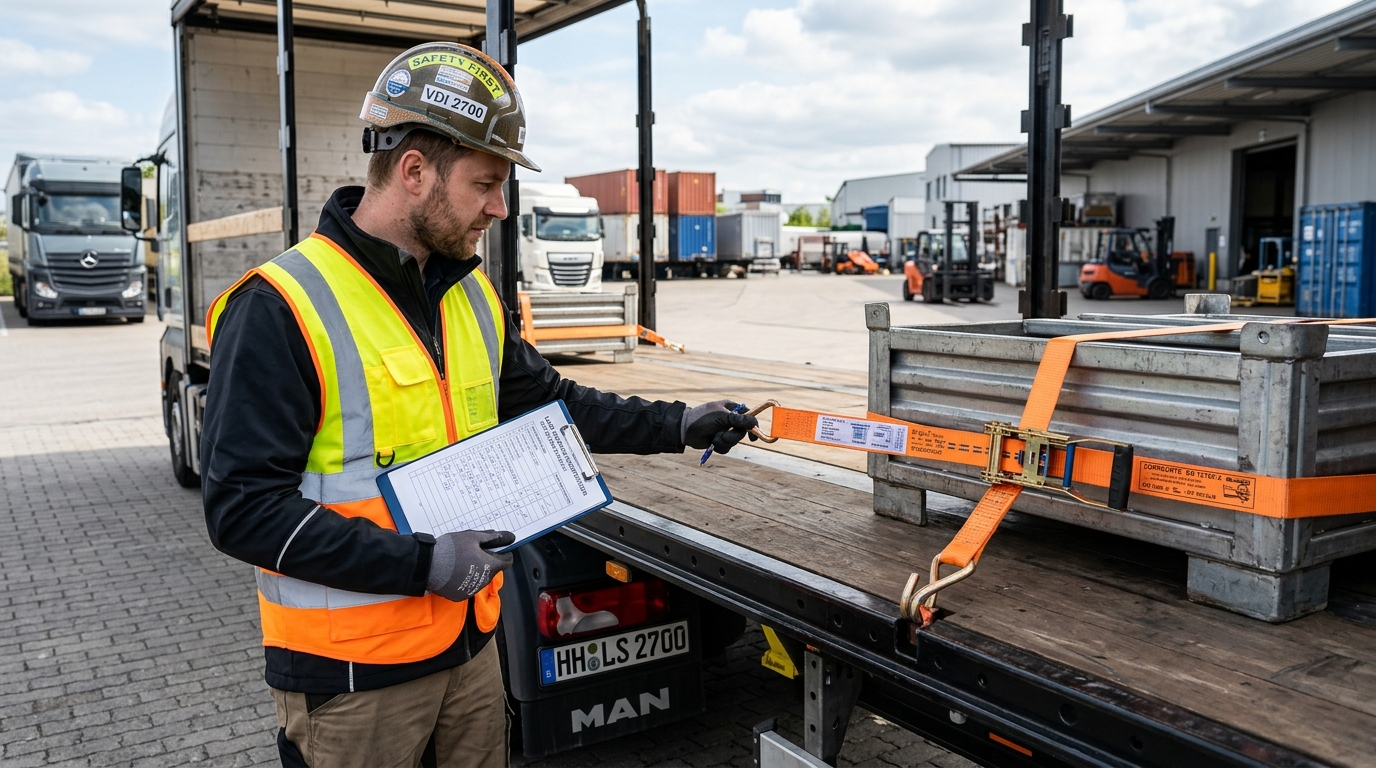
Load-Securing Officer: Duties under VDI 2700 et seq.
Discover the legal duties of a Load-Securing Officer under VDI 2700 and § 22 StVO. Learn how to legally delegate liability and avoid heavy corporate fines.
Key Takeaways
- The loader and operator share legal cargo safety responsibility alongside the driver under § 22 StVO and § 412 HGB.
- Business owners can legally delegate their personal liability to a Load-Securing Officer using written delegation under § 9 OWiG.
- Failure to secure cargo properly can result in personal fines of 80 Euro, points in Flensburg, and corporate executive liability.
- The German VDI 2700 standard defines the accepted rules of technology for safe loading and forms the basis of all legal audits.
- Professional training under VDI 2700a and structured digital documentation are mandatory to establish an audit-proof cargo organization.
Legal Fundamentals of Load Securing: Driver, Loader, and Operator Duties
In Germany, load securing is not a single employee's isolated task but a multi-layered statutory obligation distributed across multiple corporate roles. This shared legal framework is primarily defined by the German Road Traffic Act (Straßenverkehrs-Ordnung - StVO), the German Commercial Code (Handelsgesetzbuch - HGB), and the Road Traffic Licensing Regulations (Straßenverkehrs-Zulassungs-Ordnung - StVZO). Under these laws, three central actors hold distinct, non-delegable responsibilities: the driver, the loader (Verlader), and the vehicle operator (Halter). Failure to adhere to these standards can expose organizations to severe operational disruptions, regulatory penalties, and corporate liability, which is why utilizing a modern platform like CIVAC helps secure audit-proof operations.
The Statutory Split: Transport-Safe vs. Operationally Safe Loading
German commercial law makes a clear structural distinction between transport-safe loading and operationally safe loading. Under Section 412 Paragraph 1 of the German Commercial Code (HGB), the sender or loader is legally obligated to perform transport-safe loading (beförderungssichere Ladung) unless otherwise agreed by contract. This means cargo must be packed, stacked, and lashed so that the goods themselves are protected against damage during typical transport movements. Conversely, operationally safe loading (betriebssichere Ladung) falls under the duties of the carrier or driver, who must ensure that the vehicle's safe driving dynamics and center of gravity are not compromised by the weight distribution of the loaded cargo[1].
The Regulatory Framework of StVO and StVZO
While commercial law governs contract-based damages, public safety is enforced through Section 22 Paragraph 1 of the German Road Traffic Act (StVO). This public statute dictates that cargo, including any securing equipment, must be stowed and secured in such a manner that it cannot slide, tip over, fall, or create avoidable noise, even during emergency braking or sudden evasive maneuvers. This requirement applies equally to both the driver and the loader who actually stows the goods[2]. Simultaneously, Section 31 Paragraph 2 of the German Road Traffic Licensing Regulations (StVZO) targets the vehicle operator or company owner. Operators are legally prohibited from ordering or permitting the operation of a vehicle if they know, or should know, that the cargo is not safely secured or that the vehicle's road safety is compromised.
| Role (German Term) | Primary Statutory Basis | Core Load-Securing Obligations |
|---|---|---|
| Driver (Fahrer) | Section 22 StVO | Mandatory pre-departure inspection of the loaded cargo, adjusting driving style to the loaded state, and stopping the transport if the load shifts during transit. |
| Loader (Verlader) | Section 412 Paragraph 1 HGB, Section 22 StVO | Providing transport-safe packaging, physically loading and securing the cargo to prevent shifting under normal traffic force, and ensuring suitable lashing points. |
| Vehicle Operator (Halter) | Section 31 Paragraph 2 StVZO | Providing technically sound vehicles, ensuring appropriate securing gear (lashing straps, anti-slip mats), and monitoring staff selection and supervision. |
VDI 2700: The Accepted Standard of Technology
To translate these broad legal requirements into technical specifications, German courts and regulatory authorities rely on the VDI 2700 series of guidelines as the officially accepted standard of technology (anerkannte Regel der Technik). Developed by the Association of German Engineers, VDI 2700 provides the precise physical formulas, calculation methods, and testing parameters required to calculate friction, lashing angles, and securing forces for different cargo types. For corporate leaders and any appointed compliance officer or HSE lead, VDI 2700 serves as the benchmark against which safety measures are judged in court. Because these legal duties are non-delegable, corporate leaders must ensure their loading personnel are trained specifically to this standard, as responsibility for a safety failure cannot simply be contracted away to third-party drivers or independent subcontractors.
The Load-Securing Officer: Appointment and Organizational Duties under § 9 OWiG
Under German transport and commercial law, the ultimate responsibility for ensuring safe loading procedures resides with the company leadership, vehicle owners, and loading supervisors. However, in large corporate structures and active logistics departments, managing directors and HSE leads cannot personally monitor every shipment. To bridge this operational gap and build a legally sound transport compliance system, business owners can delegate their personal liability to a designated Load-Securing Officer. In German regulatory practice, this role is often designated as a Beauftragte Person für Ladungssicherung.
The primary legal mechanism for this delegation of authority is Section 9 Paragraph 2 of the German Act on Regulatory Offences (Gesetz über Ordnungswidrigkeiten, or OWiG). Under this statute, the corporate owner can delegate specific public law duties and the corresponding regulatory liabilities to a qualified specialist[3]. If executed correctly, this organizational structure transfers the immediate threat of regulatory fines from the executive board directly to the operational management level.
Strict Requirements for a Valid Written Appointment
A delegation of duties under Section 9 Paragraph 2 OWiG is only legally valid if it meets strict formal requirements. Verbal agreements or generic job descriptions are insufficient to protect corporate directors in the event of an accident, a transport damage dispute, or a police road check. To withstand judicial scrutiny, the appointment must be formalized in a precise, signed written document that outlines the specific operational limits and direct authorities of the officer.
- A formal written appointment document signed in ink by both the delegating manager and the appointed officer.
- A clear and unambiguous definition of the officer's spatial and functional scope of responsibility, such as specific shipping yards, production sites, or transport divisions.
- The explicit granting of directive authority, or Weisungsbefugnis, which allows the officer to stop unsafe loading operations and prevent non-compliant trucks from leaving the premises.
- Evidence of the officer's professional qualifications and expertise, confirming they have undergone the required technical training under VDI 2700 guidelines.
- The allocation of necessary resources, including access to securing materials and a sufficient budget to organize regular instruction sessions for the loading personnel.
Operational Control and the Non-Delegable Supervision Duty
On the shipping dock, the Load-Securing Officer often coordinates closely with the Head of Loading Activities, or Lademeister. While the Load-Securing Officer manages the overarching organization and compliance standards, the Head of Loading Activities oversees the physical securement of goods on a daily basis. This division of labor ensures that every transport vehicle complies with the stringent demands of Section 22 of the German Road Traffic Act (StVO)[4].
However, corporate leaders must understand that delegating duties does not mean total freedom from liability. Under Section 130 OWiG, managing directors retain a non-delegable duty of supervision, known as Aufsichtspflicht. This requires executive leadership to carefully select the officer, verify their continuous training, and periodically audit their performance. Integrating this role into a broader corporate framework, such as an internal compliance officer structure, provides a structured approach to managing these organizational duties and maintaining an audit-ready compliance posture.
Core Responsibilities and Training Requirements under VDI 2700
To establish a legally compliant and physically secure logistics operation in Germany, organizations must rely on qualified personnel who understand the complex technicalities of load safety. The VDI 2700a training certificate, known in German as the Ausbildungsnachweis Ladungssicherung, serves as the recognized industry standard for verifying the expertise of load-securing officers and loading personnel[5]. This qualification is highly relevant for health, safety, and environment leads, as well as internal compliance officers, who must oversee corporate safety policies and mitigate risk. By standardizing training according to these guidelines, companies can ensure that their staff is proficient in calculating securing forces, assessing vehicle limits, and preventing load movement during transit. Having a certified officer on-site is a critical step in building a robust risk-management framework that protects both personnel and corporate leadership from regulatory action.
Structure of VDI 2700a Training and Certification
The VDI 2700a curriculum is designed to transform theoretical physics into actionable safety measures on the warehouse floor. Typically spanning two days or approximately 16 instructional units, this intensive course provides participants with both theoretical knowledge and hands-on experience. Trainees learn to calculate how forces like inertia, friction, and kinetic energy affect cargo during sudden braking, tight turns, or uneven road conditions. They also gain practical experience by performing loading exercises, applying various lashing methods under supervision, and taking a final assessment. Acquiring this certification ensures that the appointed officer possesses the necessary technical authority to supervise complex loading operations and instruct other team members effectively.
- Physical Principles: Understanding mass, acceleration, kinetic energy, and how friction coefficients determine the required securing forces.
- Legal and Statutory Frameworks: Examining the concrete responsibilities of loaders, drivers, and operators under German traffic and commercial laws.
- Securing Methods: Masterclass instruction on tie-down lashing, diagonal lashing, direct lashing, and positive-fit locking techniques.
- Equipment Management: Practical evaluation of securing tools, including lashing straps, heavy-duty chains, dunnage bags, and anti-slip mats.
- Vehicle and Load Distribution: Analyzing load distribution plans to prevent overloading individual axles and to maintain vehicle stability.
While the training certificate establishes technical proficiency, companies must implement an organizational framework to sustain these standards. This is where VDI 2700 Sheet 5 becomes essential. This standard outlines quality management systems specifically for securing loads on road vehicles, helping organizations integrate safety procedures directly into their broader corporate governance[6]. For managing directors, compliance leads, and HSE officers, adopting the principles of VDI 2700 Sheet 5 is critical to prevent organizational negligence. It provides a blueprint for defining clear roles, assigning operational responsibilities, and establishing standardized safety workflows. By aligning load safety with these quality standards, companies can systematically control risks and protect their leadership from personal liability under German commercial and regulatory codes. This structured approach often links directly with broader internal compliance initiatives led by a dedicated Compliance-Beauftragter.
Daily Operational Duties and Gear Inspections
The ongoing responsibilities of a load-securing officer extend far beyond passive oversight. On a daily basis, these officers must act as the ultimate safety filter on the loading dock, executing checklist audits of outgoing vehicles to ensure that cargo is distributed and secured correctly. They verify that the vehicle payload limits are respected, and that the chosen securing methods match the physical characteristics of the freight. Furthermore, the officer is responsible for the continuous monitoring and inspection of all load-securing equipment. They must identify and immediately withdraw any damaged or worn gear from service, as faulty equipment is a primary cause of transport accidents and regulatory fines.
| Equipment Type | Inspection Focus | Critical Replacement Criteria |
|---|---|---|
| Lashing Straps (Zurrgurte) | Weaving, edges, and tensioning elements | Cuts, tearing of load-bearing fibers, deformed ratchets, or missing/illegible labels |
| Lashing Chains (Zurrketten) | Deformation, wear, and crack patterns | Elongation of individual links, visible cracks, or a reduction in link thickness by more than 10 percent |
| Anti-Slip Mats (Antirutschmatten) | Thickness, cracks, and contamination | Permanent deformation, deep cracks, severe thinning, or heavy contamination with oil and grease |
Finally, organizational compliance requires a systematic approach to staff instructions and documentation. Under German accident prevention regulations, specifically DGUV Vorschrift 1, all warehouse and loading personnel must receive regular instructions on load-securing techniques at least once a year. The load-securing officer is typically tasked with planning, executing, and documenting these sessions. To protect the organization and its directors from liability in the event of an incident, every instruction must be recorded with the date, names of participants, topics covered, and physical signatures. Transitioning these manual processes to digital tools, such as the CIVAC Workspace, allows compliance teams to maintain an audit-proof trail, monitor task fulfillment, and store training certificates securely, ensuring readiness for any regulatory inspection.
Liability Risks and the Financial Cost of Cargo Securing Failures
The legal consequences of insufficient cargo securing in Germany extend far beyond minor administrative hassles. Under the German Road Traffic Act (Straßenverkehrsordnung - StVO) and the Commercial Code (Handelsgesetzbuch - HGB), maintaining transport safety is a non-delegable corporate duty. When cargo is improperly secured, it poses a direct hazard to public safety, triggering severe liabilities that can impact multiple levels of an organization. Managing directors, dispatch managers, and safety specialists must recognize that German courts do not view load-securing failures as simple procedural errors. Instead, they are treated as significant breaches of safety regulations, exposing the company and its leadership to substantial financial, administrative, and criminal risks.
Administrative Fines and the Flensburg Point System
When German police or federal authorities (such as the Federal Office for Logistics and Mobility - BALM) detect transport violations, they apply the standardized fine catalog (Bußgeldkatalog) under Section 22 of the StVO. Both the driver (Fahrzeugführer) and the loader (Verlader) are subject to immediate administrative fines, which typically start at 60 Euro and increase to 80 Euro if a specific traffic hazard is created[7]. In addition to these financial penalties, both parties receive 1 point in the central register of traffic offenders (Fahreignungsregister) in Flensburg. For corporate organizations, these individual penalties can quickly accumulate, creating systemic records of non-compliance that damage the company's regulatory standing and can ultimately lead to the revocation of transport licenses.
| Responsible Role | Statutory Basis | Standard Fine Range | Central Register Points |
|---|---|---|---|
| Driver (Fahrzeugführer) | Section 22 & 23 StVO | 60 to 120 Euro | 1 Point |
| Loader / Head of Loading (Verlader) | Section 22 StVO | 60 to 120 Euro | 1 Point |
| Vehicle Operator / Fleet Owner (Halter) | Section 31 StVZO | Up to 270 Euro | 1 Point |
The Landmark OLG Stuttgart Decision and Personal Executive Liability
A common misconception among business leaders is that liability for cargo securing rests solely on the driver who operates the vehicle. However, German case law has firmly established a dual-responsibility framework. The landmark ruling by the Higher Regional Court of Stuttgart (Oberlandesgericht Stuttgart, Beschluss vom 27.12.1982, Az. 1 Ss (3) 848/82) made it clear that the head of loading operations (Leiter der Ladearbeiten) bears equal responsibility for ensuring that the vehicle is loaded in a road-safe manner[7]. This means that the individual supervising the dispatch area, as well as the executive management who failed to implement proper training, can be held personally liable for cargo-related accidents.
If a poorly secured load shifts and causes a traffic accident resulting in injuries, the legal consequences escalate from administrative infractions to criminal prosecution. Under Section 229 of the German Criminal Code (Strafgesetzbuch - StGB), responsible parties face charges for negligent bodily injury (fahrlässige Körperverletzung), which carries penalties of fines or imprisonment for up to three years[7]. To protect executives from these personal liabilities, a professional compliance officer must ensure that the organization maintains audit-proof documentation of all loading instructions and officer appointments. Utilizing digital tools like the CIVAC Workspace helps fleet managers and HSE leads track mandatory safety checks, manage compliance tasks, and verify that loading personnel are fully trained according to VDI 2700 standards.
Audit-Proof Compliance with CIVAC Workspace and Managed Officer Services
Managing cargo logistics within Germany requires strict adherence to technical and legal standards. Under VDI 2700, Section 22 of the German Road Traffic Act (StVO), and Section 412 of the German Commercial Code (HGB), compliance is a shared responsibility among drivers, physical loaders, and fleet operators. Failure to properly secure cargo can result in severe legal penalties, business interruptions, and personal liability for managing directors and HSE leads. To simplify these rigorous requirements, organizations can rely on CIVAC to streamline their compliance workflows. By combining digital management tools with professional, on-demand experts, the platform removes the administrative burden of maintaining safety on the road.
Streamlining Internal Workflows with CIVAC Workspace
For companies managing load-securing processes internally, maintaining an unbroken chain of documentation is often the biggest hurdle. CIVAC Workspace offers a dedicated compliance SaaS environment where HSE teams can easily coordinate mandatory tasks, training, and operational checks. Instead of relying on manual paper forms or chaotic spreadsheets, managers can digitize their entire load-securing organization. This centralized system ensures that every safety check is recorded, tracked, and verifiable in real time.
- Delegating load-securing supervisory tasks to qualified on-site staff with legally binding digital records.
- Automating the scheduling, execution, and archiving of mandatory driver and loader briefings.
- Storing structured checklist protocols, such as vehicle-specific lashing equipment inspections and trailer load limits.
- Tracking the certification status and renewal dates of designated load-securing officers.
Securing Expertise via CIVAC Externe Beauftragte
Not every company has the internal capacity or specialized knowledge to appoint a qualified load-securing officer from within their own ranks. In these situations, CIVAC Externe Beauftragte provides a reliable, legally compliant alternative. This managed service allows businesses to officially appoint certified external safety officers who take charge of organizing regular cargo-safety audits, reviewing loading guidelines, and training local teams. By integrating these external experts with the compliance platform, businesses maintain strict adherence to VDI 2700 standards without hiring full-time internal personnel.
| Compliance Dimension | Traditional / Manual Approach | CIVAC Workflow (Workspace & External Officers) |
|---|---|---|
| Task Delegation | Oral instructions or loose paperwork with high risk of liability gaps. | Legally binding digital delegation with transparent audit trails in CIVAC Workspace. |
| Training & Briefing | Siloed paper logs that are easily misplaced or allowed to expire. | Automated reminders, trackable instruction modules, and centralized digital sign-offs. |
| Audit Readiness | Stressful, retrospective file retrieval that delays regulatory audits. | Instant access to organized, real-time records, simplifying [[link:https://civac.de/audit-vorbereitung|audit preparation]] at any time. |
Ultimately, building a structured digital framework is the most effective way for German businesses and international groups to mitigate operational risk. The combined strength of CIVAC Workspace and certified experts from CIVAC Externe Beauftragte guarantees that every loading operation is performed under strict professional oversight[2]. By securing an unbroken trail of compliance documentation, management can confidently face regulatory audits, protect their workforce, and shield their organization from costly liability.
Frequently Asked Questions
Who is legally responsible for cargo securing under German law?
Under German law, cargo safety is a shared responsibility. The driver is responsible for safe driving conditions under § 23 StVO, while the loader (Verlader) must ensure safe loading under § 22 StVO. Additionally, the sender must load the goods securely under § 412 HGB, and the vehicle operator (Halter) is liable under § 31 StVZO.
Can management delegate cargo safety liability to an officer?
Yes. Under § 9 Paragraph 2 OWiG, a business owner can formally delegate their personal duties and liability to a designated Load-Securing Officer (BPL). This delegation must be executed in writing, explicitly outlining the officer's tasks, authority, and operational responsibilities.
What are the qualification requirements for a Load-Securing Officer?
The officer must possess the necessary expertise and technical knowledge. This is typically achieved by completing a certification course according to VDI 2700a. They must also remain updated on the latest cargo safety guidelines and the official technical rules under VDI 2700.
What fines apply for improper cargo securing in Germany?
If a vehicle is loaded unsafely and traffic safety is severely compromised, the standard fine is 80 Euro for the driver or loader, along with 1 point in the Flensburg register. If an accident occurs due to poor securing, the managing directors may face criminal charges for bodily injury by negligence.
How does the OLG Stuttgart ruling affect loader liability?
The landmark OLG Stuttgart ruling established that the statutory responsibility of the loader (Verlader) under § 22 StVO applies not only to the physical loading staff but extends directly to the company management, who must organize and monitor the entire loading department.
What is the difference between VDI 2700 and VDI 2700a?
VDI 2700 is the main technical directive series that defines the standards and calculations for securing loads on road vehicles. VDI 2700a is the specific sheet of that series which defines the training standards, curricula, and examination criteria for cargo safety personnel.
Sounds like a lot of work?
Officer duties, deadlines, paperwork — that's exactly what we take off your hands. Say hello and we'll show you how.
The officer role behind this article
Turn this into a mandate.
Let us carry the operational weight. External officer, templates and documentation in one workspace. No obligation.

Sections 6, 17, 45 ElektroG: registration before placing on the market, take-back from 400 square metres, fines up to EUR 100,000