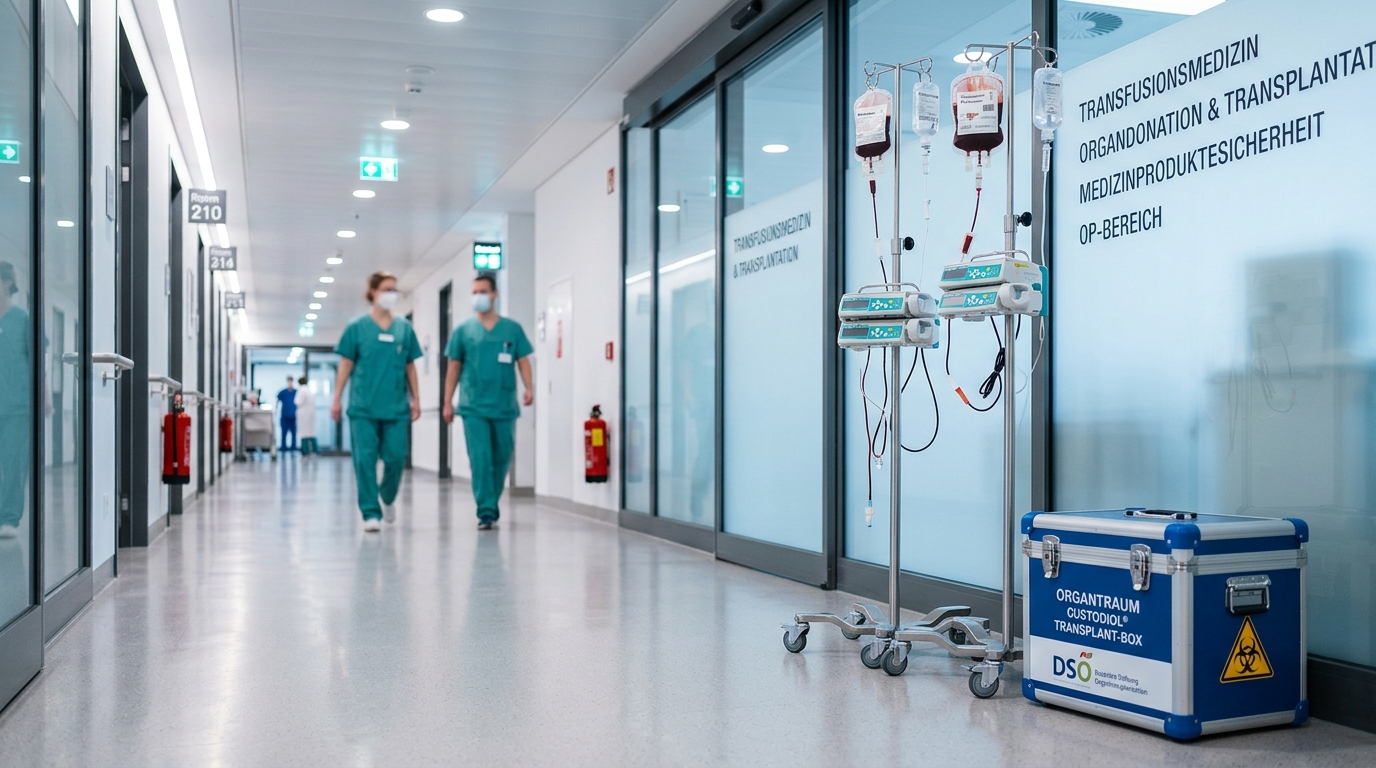
Transfusion, Transplantation and Medical-Device Officers in Hospitals
A guide to the legal duties, training, and liability risks for Transfusion, Transplantation, and Medical-Device Safety Officers in German hospitals.
Key Takeaways
- Transfusion Officers must complete a specialized 16-hour curriculum based on the German Transfusion Act (TFG).
- German procurement hospitals must release Transplantation Officers by at least 0.1 FTE for every 10 intensive care beds.
- Hospitals with more than 20 employees must appoint a dedicated Medical-Device Safety Officer under MPBetreibV § 6.
- Non-compliance with clinical officer mandates can lead to severe director liability and administrative fines of up to EUR
Clinical Compliance in German Healthcare Operations
Operating a hospital within Germany represents one of the most heavily regulated compliance undertakings in European healthcare. According to official federal statistics, Germany has 1,874 hospitals that collectively manage over 17.2 million patient treatments annually[1]. Within this high-volume environment, clinical compliance is not merely an ethical framework but a rigorous legal necessity. Managing directors, hospital boards, and clinical leaders must navigate a dense network of federal laws and clinical guidelines to secure institutional funding and maintain operating licenses. In this landscape, the structured appointment of specialized hospital officers is a mandatory shield protecting patients from harm and safeguarding directors from personal liability.
The operational risks in modern medicine are highly concentrated around clinical interfaces such as blood transfusions, organ donations, and medical device usage. When these critical areas are unmanaged, hospital executives face significant exposure to corporate liability, regulatory fines, and even criminal charges under German law. To prevent organizational failure, the legislator mandates specific officer roles that act as dedicated supervisors for these high-risk areas. These clinical compliance roles bridge the gap between complex legal statutes and the daily clinical routine, ensuring that safety protocols are strictly integrated into ward activities and medical workflows.
Structuring Hospital Risk Management Around Specialized Officers
Under German law, three core roles form the backbone of clinical compliance in acute care facilities: the Transfusion Officer, the Transplantation Officer, and the Medical-Device Safety Officer. Each role addresses a distinct, high-impact clinical pathway. Together, they establish a robust quality assurance loop that spans from patient admission to therapeutic intervention. By implementing standardized observation, reporting, and documentation procedures, these corporate officers ensure that the hospital meets federal quality standards and maintains an audit-proof record of compliance. When coordinating overall risk management, aligning these clinical functions with a general compliance officer or an internal HSE lead helps hospitals build a cohesive defense against both legal and medical failures.
- Direct Statutory Mandates: Appointment duties are anchored in federal laws, including the German Transfusion Act (TFG) and the German Transplantation Act (TPG), leaving no room for administrative omission.
- Mandatory Professional Qualifications: Each role requires a precise blend of medical experience, specialist training, and continuous professional development specified by federal bodies.
- Corporate Liability Mitigation: Formal appointments and clearly defined competencies shield the managing directors from claims of organizational negligence (Organisationsverschulden).
- Audit-Ready Documentation: Every safety check, clinical incident report, and compulsory training session must be recorded in a traceably structured and permanent format.
Managing these roles internally is a major administrative challenge for healthcare executives. Managing directors must oversee recruitment, ensure regular training updates, and track compliance workflows across multiple medical departments. To maintain continuous oversight and avoid critical operational blind spots, modern hospital operators rely on structured digital workspaces. Implementing a centralized solution like the CIVAC Workspace enables clinical leaders to coordinate mandatory officer tasks, manage delegation, and maintain a centralized, audit-proof history of all corporate compliance activities.
The Transfusion Officer: Ensuring Safe Blood Product Application
Under German clinical law, the administration of blood products and plasma derivatives is tightly regulated to prevent severe medical risks and ensure absolute patient safety. According to Section 15 of the German Transfusion Act (Transfusionsgesetz - TFG) and the binding Hemotherapy Guideline (Richtlinie Hämotherapie) of the German Medical Association (Bundesärztekammer) and the Paul-Ehrlich-Institut, hospitals and medical facilities that apply blood products must establish a rigorous quality assurance system[2]. This legal framework dictates that every clinical treatment unit utilizing blood components or plasma derivatives must formally appoint a qualified Transfusion Officer (Transfusionsbeauftragter) to oversee the daily safety, compliance, and administration of these products in a clinical setting[3]. This corporate appointment forms a critical component of broader medical compliance oversight, managed closely by internal Compliance Officers and clinical management teams.
Legal Obligation and Appointment Scope
The obligation to appoint a Transfusion Officer applies to any department or medical unit involved in hemotherapy, including operating rooms, intensive care units, and specialized wards. For smaller hospitals or clinics, a centralized Transfusion Officer may suffice if they can effectively cover all clinical units, but in larger medical centers, each specific treatment unit must have its own designated officer. The appointment must be made in writing by the hospital's management board and clearly define the officer's clinical and regional scope of responsibility. Failure to establish this role constitutes a direct breach of clinical quality assurance standards under Section 15, Paragraph 2 of the TFG, exposing the organization's executives to significant regulatory and organizational liability.
Core Duties and Clinical Responsibilities
The Transfusion Officer acts as the primary clinical custodian for blood product safety within their assigned unit. Their responsibilities span from supervising correct storage and cross-matching protocols to ensuring complete traceability of every administered blood unit.
- Monitoring of all hemotherapy practices within the treatment unit to guarantee compliance with the Hemotherapy Guideline[2].
- Supervising the proper documentation of all transfusions, including the exact recording of patient consent, product batch numbers, and transfusion outcomes to ensure full traceability under the Transfusion Act (TFG).
- Immediate reporting of suspected transfusion reactions or adverse events to the centralized Transfusion Responsible Doctor (Transfusionsverantwortlicher) and assisting in rapid look-back procedures.
- Conducting regular internal briefings and training sessions for nursing and medical staff regarding blood application safety protocols.
- Participating in the hospital's Transfusion Commission to continuously audit, refine, and update the institution's hemotherapy quality management systems.
Strict Qualification, Training, and Liability Risks
To be appointed as a Transfusion Officer, the candidate must be a licensed physician (Arzt/Ärztin) with a minimum of three years of clinical medical experience[4]. Furthermore, they must complete a specialized curriculum, which typically involves a 16-hour structured training course recognized by the state medical association (Landesärztekammer) covering hemotherapy, transfusion medicine, and quality management[5]. Neglecting these requirements or failing to properly document the appointment and clinical workflows can lead to severe consequences. Under Section 31 of the TFG, administrative regulatory offenses (Ordnungswidrigkeiten) and failures to execute quality assurance systems or trace blood products can result in substantial administrative fines. Additionally, hospital managers face severe organizational culpability (Organisationsverschulden) under civil law if an adverse event occurs and the clinic cannot prove an audit-proof, qualified appointment process.
The Transplantation Officer: Coordinating Organ Donation Processes
Under Section 9b of the German Transplantation Act (Gesetz über die Spende, Entnahme und Übertragung von Organen - TPG), all procurement hospitals (Entnahmekrankenhäuser) are legally required to designate at least one qualified physician as a Transplantation Officer (Transplantationsbeauftragter)[6]. Hospital compliance leads and managing directors must treat this role as an essential pillar of their clinical risk management, integrating it into the broader framework for internal compliance officers to avoid operational silos.
Statutory Release from Clinical Duties
One of the most significant regulatory developments in German healthcare compliance was the statutory strengthening of the Transplantation Officer's release from regular clinical duties (Freistellung) under Section 9b Paragraph 1 of the TPG. Hospitals are legally required to release these officers from their day-to-day medical duties to ensure they have sufficient time to perform their statutory tasks. This is not a voluntary accommodation but a strict compliance requirement, with the release time calculated based on the size of the hospital's intensive care unit and the historical volume of potential donor cases. For managing directors, failing to guarantee this statutory release can lead to severe operational bottlenecks, compliance audits, and potential administrative fines.
Core Duties and Operational Responsibilities
The everyday duties of a Transplantation Officer are diverse and require a high degree of clinical and psychological expertise. Their responsibilities begin with the early identification of potential organ donors within intensive care units and the immediate notification of the coordination center. Furthermore, they are responsible for counseling the families of potential donors, guiding them through the legal and emotional complexities of consent. They must also coordinate clinical procedures with external medical teams during organ procurement and ensure that the hospital's internal guidelines for organ donation are regularly updated. These processes must be fully documented in an audit-proof manner to comply with healthcare regulatory standards.
| Regulatory Parameter | Statutory Requirement under Section 9b TPG |
|---|---|
| Legal Basis | Section 9b of the German Transplantation Act (TPG) in conjunction with state hospital laws |
| Appointing Obligation | Mandatory for all designated procurement hospitals (Entnahmekrankenhäuser) in Germany |
| Required Qualification | Licensed physician with several years of clinical experience, specifically in intensive care medicine |
| Statutory Release | Mandatory release from clinical duties proportional to the intensive care unit size and donor volume |
| Liability Risks | Administrative fines for non-appointment and potential institutional liability for procedural non-compliance |
To establish a robust clinical compliance framework, healthcare operators must manage the appointment, qualifications, and tasks of transplantation officers with the same rigor applied to other corporate officer roles. Since many state laws in Germany require continuous education and detailed annual reporting on potential donor identification, keeping manual records is no longer viable. Implementing a centralized compliance platform ensures that all certifications are up to date and that the hospital remains fully audit-proof. By systematizing these legal appointments, hospital management teams can mitigate administrative liabilities, protect clinical staff, and focus on delivering excellent patient care while meeting all statutory obligations under German law.
The Medical-Device Safety Officer: Managing Equipment and Incident Risks
The high density of complex diagnostic and therapeutic technology in modern hospitals makes technical safety a core compliance priority. Under Section 6 of the German Medical Devices Operator Ordinance (Medizinprodukte-Betreiberverordnung, MPBetreibV), healthcare facilities with more than 20 employees are legally mandated to appoint a dedicated Medical-Device Safety Officer (Beauftragter für Medizinproduktesicherheit)[7]. This role acts as the central link connecting clinical users, hospital management, device manufacturers, and federal supervisory bodies like the BfArM. Failing to designate this officer is not a minor oversight; it represents a significant compliance breach that exposes clinical operations to legal and operational risk.
Core Duties and Incident Coordination
The primary responsibility of the Medical-Device Safety Officer is to serve as a reliable, rapid-response contact point for external partners regarding risks, defects, and safety notices. When a safety alert or recall occurs, the officer must lead internal efforts to locate the affected equipment, coordinate the required corrections, and ensure compliance with statutory reporting duties. They must also ensure that clinical staff receive proper training on the devices they operate, reducing user errors that could lead to patient harm.
- Central Contact: Serving as the main contact point for the BfArM, manufacturers, and distributors regarding product risks.
- Internal Risk Coordination: Designing and overseeing internal workflows that guarantee the immediate reporting and documentation of medical device incidents.
- Recall Management: Coordinating the rapid implementation of field safety corrective actions and product recalls in clinical wards.
- Operational Compliance: Collaborating with nursing leads and technical staff to ensure all devices are regularly inspected and maintained.
Professional Qualifications and Technical Expertise
Not everyone is suited for this specialized position. Under German regulations, the appointed officer must possess specific professional expertise, reliability, and an academic or professional background in a relevant scientific, medical, nursing, pharmaceutical, or technical field. While many candidates complete supplementary training certificates to align with the European Medical Device Regulation (EU MDR), their qualification remains anchored in a combination of solid technical knowledge and a practical understanding of clinical risk management workflows.
Appointment Documentation, Liability, and Fine Exposure
Under the MPBetreibV, hospital operators must not only formally designate this officer but also establish a functional, public-facing email address on the hospital website to guarantee that external manufacturers and regulatory authorities can initiate immediate contact. Neglecting this appointment obligation constitutes an administrative offense (Ordnungswidrigkeit), which can be penalized with significant regulatory fines[8]. For internal compliance officers and executive boards, tracking these requirements alongside other mandatory corporate roles is a critical task. Utilizing digital workspaces like the CIVAC Workspace ensures that appointment certificates, contact channels, and risk protocols are kept up to date and fully ready for regulatory audits.
Hassle-Free Compliance: How CIVAC Simplifies Officer Management
Hospitals and clinical environments operate under some of the strictest regulatory frameworks in Germany. Appointing, training, and tracking multiple specialized roles, such as transfusion, transplantation, and medical-device safety officers, places an immense administrative burden on hospital management. In fact, healthcare organizations globally face massive administrative pressures, with compliance activities requiring significant human and financial resources to avoid severe liability and penalty risks[9]. To alleviate this operational strain, CIVAC offers an integrated approach that combines advanced compliance software with certified external expertise, ensuring absolute legal security with zero administrative overhead.
Streamlining Clinical Roles with CIVAC Workspace
For healthcare facilities that manage their corporate officer roles internally, the compliance platform known as CIVAC Workspace serves as the central digital hub. This compliance SaaS platform eliminates fragmented spreadsheets and loose paper documentation by unifying task management, mandatory training, and audit trails into a single intuitive interface. Hospital compliance directors can assign specific legal obligations to transfusion, transplantation, or medical-device safety officers, monitor execution in real time, and verify that all statutory qualifications are up to date. This centralized oversight drastically reduces the likelihood of missing a mandatory medical device inspection or failing a clinical audit.
- Centralized task tracking: Automatically schedules and monitors repetitive legal tasks, such as medical device safety inspections and staff training deadlines.
- Audit-proof documentation: Keeps a complete digital record of appointments, certifications, and task completion for regulators and external auditors.
- Integrated training modules: Enables seamless onboarding and continuous education for specialized hospital officers to maintain required expertise.
Legal Security via CIVAC Externe Beauftragte
When internal resources are scarce or clinical leads lack the highly specialized legal qualifications required for specific officer roles, hospitals can turn to CIVAC Externe Beauftragte. Through this professional managed service, hospitals can appoint certified, individually appointed external officers for various corporate compliance roles. This external model transfers the administrative liability and execution risk to external experts, ensuring that the hospital remains fully compliant with German statutes like the German Transfusion Act (Transfusionsgesetz - TFG) or the German Medical Devices Implementation Act (Medizinprodukte-Durchführungsgesetz - MPDG). This service seamlessly integrates with audit preparation workflows, transforming regulatory burden into a streamlined, risk-mitigated operation.
| Compliance Dimension | CIVAC Workspace (Internal) | CIVAC Externe Beauftragte (External) |
|---|---|---|
| Core Advantage | Centralizes task tracking and documentation for internal hospital staff. | Outsources the officer role and administrative liability to certified experts. |
| Administrative Burden | Significantly reduced through automation and digital workflows. | Eliminated entirely as external officers handle all routine obligations. |
| Audit Readiness | Continuous tracking provides instant proof of compliance during inspections. | Direct expert support and complete audit-proof digital records. |
Ultimately, utilizing these integrated compliance solutions ensures that healthcare facilities remain fully aligned with evolving German and European clinical standards. By combining robust digital organization with qualified compliance expertise, hospitals protect their leadership from severe regulatory fines, eliminate organizational liability, and maintain a seamless audit trail for every statutory inspection. This comprehensive framework allows hospital directors and medical leads to refocus their primary energy and valuable hospital resources where they matter most, delivering outstanding clinical excellence and superior patient care.
Frequently Asked Questions
Who is required to appoint a Transfusion Officer under German law?
According to § 15 of the German Transfusion Act (TFG) and the Hemotherapy Guideline, any hospital treatment unit that administers blood products or blood-derived medicines is legally required to appoint a Transfusion Officer. This officer must be a qualified physician who oversees safe application, monitors transfusion processes, and ensures seamless documentation.
What is the minimum release time for a Transplantation Officer?
Under § 9b Abs. 3 of the German Transplantation Act (TPG), procurement hospitals must release Transplantation Officers from clinical duties. The statutory minimum release is 0.1 full-time equivalent (FTE) for every 10 intensive care beds. For hospitals containing specialized transplantation centers, the minimum release rises to a full 1.0 FTE.
Does a hospital with fewer than 20 employees need a Medical-Device Safety Officer?
No, under § 6 of the Medical Devices Operator Ordinance (MPBetreibV), the mandatory appointment of a Medical-Device Safety Officer only applies to healthcare facilities that regularly employ more than 20 staff members. Smaller facilities are exempt from this specific appointment but must still comply with general medical device safety and tracking regulations.
What are the qualification requirements for a Transfusion Officer?
A Transfusion Officer must be a licensed physician with clinical experience in patient care. They are required to complete a standardized 16-hour training curriculum in clinical transfusion medicine, which is approved by the German Medical Association (Bundesärztekammer) and covers blood safety, administration, and adverse-reaction management.
What are the consequences of failing to appoint a Medical-Device Safety Officer?
Failing to designate a Medical-Device Safety Officer when meeting the 20-employee threshold is classified as an administrative offense under the German Medical Devices Implementation Act (MPDG) and the MPBetreibV. This violation can expose the hospital and its directors to administrative fines of up to EUR and severe liability in the event of an equipment-related patient incident
Can several procurement hospitals share a single Transplantation Officer?
Yes, § 9b Abs. 4 of the German Transplantation Act (TPG) allows multiple procurement hospitals to arrange a shared Transplantation Officer via written agreement, provided this is permitted by state law. However, the agreement must guarantee that the officer can fully and properly perform all statutory donor identification and coordination duties at each individual facility.
Sounds like a lot of work?
Officer duties, deadlines, paperwork — that's exactly what we take off your hands. Say hello and we'll show you how.
The officer role behind this article
Sources
- destatis.de
- bundesaerztekammer.de
- laek-thueringen.de
- iakh.de
- akademie-nordrhein.de
- gesetze-im-internet.de
- gesetze-im-internet.de
- betriebsarzt.online
- compliancy-group.com
- CIVAC - Wir übernehmen Compliance
- Audit-Vorbereitung mit CIVAC
- Die CIVAC Compliance-Plattform
- Compliance-Beauftragter: Pflichten, Bestellung, AI Act 2026
Turn this into a mandate.
Let us carry the operational weight. External officer, templates and documentation in one workspace. No obligation.

Sections 6, 17, 45 ElektroG: registration before placing on the market, take-back from 400 square metres, fines up to EUR 100,000