Energy Management Officer under ISO 50001 and the German EnEfG
A compliance guide for the Energy Management Officer in Germany under ISO 50001 and EnEfG, detailing thresholds, duties, liability, and software.
Key Takeaways
- Companies consuming over 7.5 GWh of energy annually must implement a full ISO 50001 or EMAS system under EnEfG Section 8.
- Non-SMEs with energy consumption below 7.5 GWh must conduct energy audits every four years under EDL-G Section 8.
- Failing to implement required energy efficiency or audit measures can lead to regulatory fines of up to 100,000 euros under EnEfG.
- Energy Management Officers require specialized technical training to handle mandatory waste heat evaluations and audit reporting.
Introduction: The Evolving Energy Compliance Landscape in Germany
Germany has embarked on an ambitious regulatory pathway to achieve climate neutrality by 2045. As part of this national transformation, energy efficiency is no longer treated as a voluntary component of corporate sustainability reports or environmental marketing campaigns. Instead, driven by the recast of the European Energy Efficiency Directive (EED), German lawmakers have turned energy management into a strict, statutory compliance mandate[1]. For managing directors, compliance officers, and health, safety, and environment (HSE) leads, ignoring these regulations carries significant liability risks, making structured oversight essential.
Historically, corporate energy obligations in Germany were primarily regulated under the German Energy Services Act (Energiedienstleistungsgesetz - EDL-G). This statute required all large, non-SME organizations to conduct an energy audit in accordance with DIN EN 16247-1 every four years[2]. Alternatively, companies could exempt themselves from this periodic audit by implementing a fully certified Energy Management System (EnMS) under DIN EN ISO 50001 or an environmental management system under EMAS. While the EDL-G focused heavily on corporate size, recent legislation has shifted the legislative focus directly to actual energy consumption thresholds.
The regulatory landscape was permanently altered with the enactment of the German Energy Efficiency Act (Energieeffizienzgesetz - EnEfG) in November 2023. Under the EnEfG, companies with an average annual final energy consumption of more than 7.5 GWh over the last three fiscal years are now legally required to implement and certify an energy or environmental management system under ISO 50001 or EMAS[3]. Additionally, companies with annual consumption exceeding 2.5 GWh must prepare and publish concrete implementation plans for identified energy-saving measures. To integrate these complex operational and legal requirements, businesses increasingly rely on a qualified Energy Management Officer to steer the technical and administrative processes.
| Regulatory Instrument | Legal Basis | Applicability Threshold | Mandated Action |
|---|---|---|---|
| EDL-G (German Energy Services Act) | § 8 EDL-G | All non-SMEs (companies with 250+ employees or over 50 million EUR turnover, unless annual consumption is 500,000 kWh or less) | Perform a certified DIN EN 16247-1 energy audit every 4 years, or maintain an ISO 50001 or EMAS system |
| EnEfG (German Energy Efficiency Act) | § 8 EnEfG | Average annual final energy consumption over 7.5 GWh over the last 3 fiscal years | Implement and certify an Energy Management System (ISO 50001) or EMAS within 20 months of triggering the threshold |
| EnEfG (German Energy Efficiency Act) | § 9 EnEfG | Average annual final energy consumption over 2.5 GWh over the last 3 fiscal years | Formulate, certify, and publish specific implementation plans for all economic energy-saving measures within the organization |
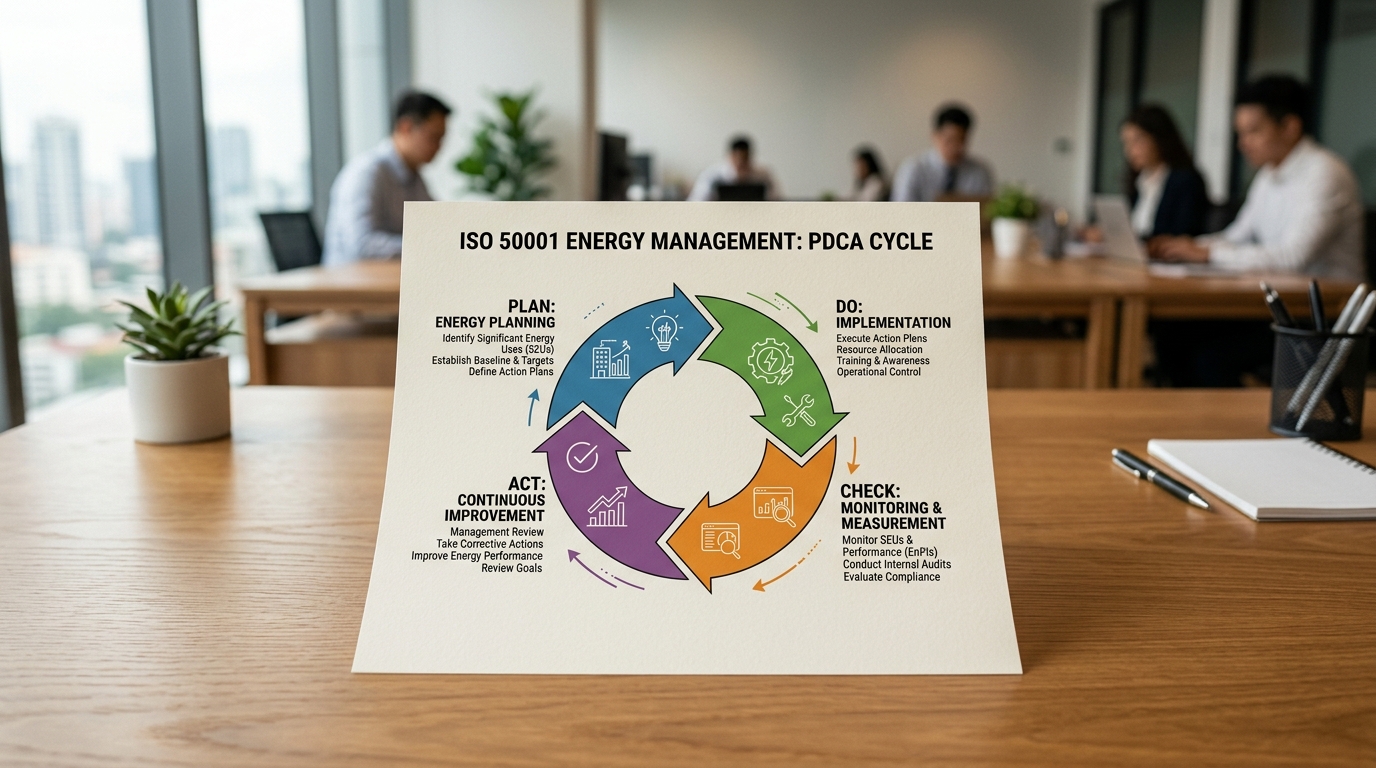
Managing these parallel statutory duties demands structured, continuous oversight. Implementing an EnMS is not a one-time setup; it is a continuous improvement cycle that requires deep technical expertise, regular internal audits, and direct reporting to executive management. Coordinating this complex environment often overlaps with other corporate safety and environmental roles. For companies looking to harmonize their legal appointments, aligning energy management with a broader governance structure under a certified Compliance Officer ensures that regulatory risks are handled systematically. Ensuring systematic audit preparation can streamline the certification of these systems, protecting the organization from severe administrative fines.
Legal Framework: EnEfG and the ISO 50001 Implementation Mandate
For managing directors, compliance leaders, and health, safety, and environment (HSE) leads operating within Germany or managing international groups with German branches, energy compliance has evolved from a voluntary corporate social responsibility initiative into a strict statutory obligation. The primary driver of this shift is the German Energy Efficiency Act (Energieeffizienzgesetz - EnEfG), which codified rigorous energy-saving targets for companies. Under Section 8 EnEfG, the regulatory landscape establishes a clear, consumption-based threshold that triggers the mandatory implementation of structured energy management workflows. Failing to identify these thresholds and appoint the necessary operational personnel exposes corporate leadership to significant regulatory scrutiny and administrative fines.
The 7.5 GWh Threshold and Implementation Deadlines
Under Section 8 Paragraph 1 of the EnEfG, any company with an average annual total final energy consumption exceeding 7.5 gigawatt hours (GWh) over the last three fiscal years is legally obligated to set up and operate a certified Energy Management System (EnMS) according to DIN EN ISO 50001 or an Environmental Management System (EMS) according to EMAS. The law enforces a strict implementation period: affected businesses must establish this certified system within 20 months of reaching the consumption threshold or, for companies that already exceeded the limit when the statute took effect on November 18, 2023, by July 18, 2025[4]. This timeline requires rapid, highly organized deployment of internal expertise or the sourcing of qualified external partners.
Waste Heat and Implementation Plan Obligations
The legal framework does not stop at high-level consumption. Section 9 of the EnEfG introduces a secondary threshold at an average annual consumption of more than 2.5 GWh (with legislative drafts proposing an adjustment to 2.77 GWh to align with European directives)[5]. Companies crossing this boundary must draft and publish concrete, feasible execution plans for all energy-saving measures identified during their audits or management system cycles. Furthermore, Section 16 EnEfG mandates that companies determine the waste heat generated within their operational processes, take technical steps to avoid or reduce it, and report detailed waste heat data to the Federal Office for Economic Affairs and Export Control (BAFA) via the central Platform for Waste Heat[6]. Many organizations integrate these technical reporting streams directly into the portfolio of their compliance officer to prevent siloed data and ensure systematic legal adherence.
| Average Annual Energy Consumption | Legal Mandate under German EnEfG | System Requirements & Key Deadlines |
|---|---|---|
| > 7.5 GWh | Mandatory establishment of a certified energy or environmental management system under Section 8 EnEfG | ISO 50001 or EMAS certification within 20 months of reaching the threshold |
| > 2.5 GWh (Draft: > 2.77 GWh) | Mandatory execution plans under Section 9 EnEfG and mandatory waste heat reporting under Section 16 EnEfG | Publish feasible energy-saving plans and submit waste heat data to the federal BAFA platform |
Implementing these complex requirements demands a dedicated functional lead who can translate abstract statutory thresholds into actionable tasks, organize mandatory employee training, and maintain audit-proof documentation. This role is typically fulfilled by a specialized Energy Management Officer. To prepare your organization for the intensive documentation demands of a third-party ISO 50001 audit or BAFA inspection, proactive audit preparation is crucial to avoid procedural gaps and protect management from administrative liabilities.
Energy Audits under EDL-G and DIN EN 16247-1 for Non-SMEs
For companies operating in Germany that do not meet the high-consumption thresholds of the newly introduced German Energy Efficiency Act (Energieeffizienzgesetz - EnEfG), energy compliance is still a critical legal mandate. Under the German Energy Services Act (Energiedienstleistungsgesetz - EDL-G), all companies classified as non-SMEs are required to systematically inspect their energy consumption. This compliance pathway is fulfilled by conducting a regular energy audit in accordance with the DIN EN 16247-1 standard[7]. Unlike the continuous improvement process of a full energy management system, a DIN EN 16247-1 audit provides a periodic snapshot of energy flows, helping organizations identify cost-effective conservation measures without the administrative overhead of a continuous ISO 50001 system.
Defining Non-SME Status and Obligation Thresholds
The obligation to perform a DIN EN 16247-1 audit applies to all organizations that qualify as non-SMEs under the guidelines of the European Commission. Specifically, a company is deemed a non-SME if it employs 250 or more people, or if it has fewer than 250 employees but registers an annual turnover exceeding 50 million EUR and an annual balance sheet total exceeding 43 million EUR. This assessment must take into account partner and linked enterprises, which often brings German subsidiaries of international groups into scope regardless of their local headcount. Organizations meeting these criteria must carry out their first energy audit within twenty months of reaching non-SME status and must repeat the audit at least every four years from the date of the previous audit.
| Criteria | DIN EN 16247-1 Energy Audit | ISO 50001 EnMS |
|---|---|---|
| Scope and Nature | A periodic systematic assessment of energy use. | A continuous, system-wide management framework. |
| Timeframe | Repeated every four years. | Continuous operation with annual surveillance audits. |
| Organizational Effort | Moderate effort focused on data collection and analysis. | High effort requiring dedicated roles and internal audits. |
| Regulatory Suitability | Ideal for companies below the EnEfG consumption thresholds. | Recommended for high-consumption enterprises under the EnEfG. |
The Federal Office for Economic Affairs and Export Control (Bundesamt für Wirtschaft und Ausfuhrkontrolle - BAFA) is responsible for monitoring compliance with the EDL-G in Germany. BAFA conducts regular spot checks to verify that audits have been completed on time, conform to DIN EN 16247-1, and have been registered through the official online portal. Failing to complete the energy audit, performing it late, or using an unqualified auditor constitutes an administrative offense under Section 12 of the EDL-G, which can result in administrative fines of up to 50,000 EUR. Therefore, managing directors must ensure that the internal compliance officer or designated energy lead coordinates these audits on time.
Key Implementation Phases and Auditor Qualifications
- Initiation and kick-off meeting to define the scope, boundaries, and energy sources to be analyzed.
- Data collection involving the systematic gathering of energy consumption data for electricity, heating, processes, and logistics.
- Field visits to inspect energy-using systems, infrastructure, and operational practices directly.
- Analysis and evaluation of energy flows to identify concrete, cost-effective energy saving opportunities.
- Reporting and final meeting to present the audit results and provide the mandatory documentation for BAFA.
To ensure that the energy audit is legally compliant and recognized by BAFA, the selected auditor must possess the necessary professional qualifications. Under Section 8b of the EDL-G, auditors must have specific expertise in energy efficiency and be registered on the official BAFA list of qualified energy consultants. Implementing these recurring audits requires precise project planning and rigorous tracking of historical consumption data. Utilizing compliance management systems for systematic audit preparation allows compliance officers to maintain all historical energy reports, auditor credentials, and submission confirmations in a centralized, audit-proof environment, reducing the risk of regulatory oversight.
Operational Duties and Qualification Requirements for Energy Management Officers
The Energy Management Officer (Energiemanagementbeauftragter or EnMB) plays a critical role in establishing and maintaining an energy management system (EnMS) according to the DIN EN ISO 50001 standard. Under the German Energy Efficiency Act (Energieeffizienzgesetz, or EnEfG), companies with an annual average energy consumption exceeding 7.5 GWh over the preceding three years must implement such a system[8]. For managing directors (Geschäftsführer) and HSE leads, appointing a competent EnMB is the most effective way to coordinate the energy team, manage compliance risks, and establish sustainable energy-saving measures across all organizational units. The officer acts as the central link between technical operations and senior leadership.
Core Operational Duties under ISO 50001
The core operational duties of the EnMB under ISO 50001 involve steering the continuous improvement of the organization's energy performance. According to professional guidelines from the German Association for Quality (Deutsche Gesellschaft für Qualität, or DGQ), the officer is responsible for creating and maintaining robust energy data collection pipelines[9]. This includes identifying significant energy uses (SEUs), defining energy baselines (EnBs), and monitoring key Energy Performance Indicators (EnPIs). Furthermore, the officer coordinates internal energy audits, prepares the management review for executive board meetings, and monitors the implementation of concrete technical measures to optimize consumption.
Beyond technical tracking, the EnMB must communicate progress and requirements to diverse business units. Without proper software, maintaining the extensive documentation required for ISO 50001 re-certification and EnEfG verification can quickly become a massive administrative burden. Implementing a digital system like the CIVAC Workspace allows organizations to manage all compliance-related tasks, assign roles to internal team members, and handle mandatory employee training within a single platform. This ensures that every energy-saving initiative is backed by an audit-proof trail, streamlining the entire audit preparation process.
Required Qualifications and Expert Criteria
To successfully execute these duties, the EnMB must possess a deep understanding of energy technology, legal obligations, and management standard implementation. Although German law does not enforce a rigid academic curriculum for this position, certification bodies such as TÜV or DGQ require evidence of specific training and expert qualification criteria. Candidates typically possess a background in engineering, environmental technology, or industrial management, combined with structured training in ISO 50001 audit methodologies, data analysis, and energy-saving calculations.
| Qualification Dimension | Focus Areas and Competencies | Industry-Standard Credentials |
|---|---|---|
| Technical Knowledge | Energy flow analysis, measuring technology, calculation of energy performance indicators (EnPIs), waste heat recovery principles | Certified Energy Manager, Engineering Degree, environmental science background |
| Standard and Regulatory Competence | Detailed requirements of DIN EN ISO 50001, German EnEfG compliance, EDL-G audits under DIN EN 16247-1 | ISO 50001 Implementation Specialist or Lead Auditor |
| Project and Audit Execution | Internal energy auditing, data pipeline setup, preparing management reviews, coordinating action plans | TÜV or DGQ Certified Energy Management Officer |
As the regulatory landscape in Germany continues to tighten, the qualification requirements for the EnMB must be updated continuously. New provisions under the EnEfG force companies to document and publicly declare waste heat sources, which places a heavy technical demand on internal compliance and engineering teams. Organizations that struggle to find or train internal experts can leverage specialized external support. By utilizing CIVAC Externe Beauftragte, businesses can appoint certified external experts who take over operational duties, simplify compliance processes, and ensure full compliance without the delay of internal training pipelines.
Corporate Appointment, Documentation, and Statutory Liability Exposure
Under German law, specifically the Energy Efficiency Act (Energieeffizienzgesetz - EnEfG) and the Energy Services Act (Energiedienstleistungsgesetz - EDL-G), managing directors and board members bear direct responsibility for corporate energy compliance[10]. To fulfill these statutory duties legally and protect the organization during regulatory audits, executive leadership must establish robust, formal appointment processes and maintain comprehensive documentation. Failing to formalize these appointments or properly log energy metrics not only undermines the efficiency of the organization but also leaves the business open to significant legal vulnerabilities during official checks.
The Formal Appointment Process and Documentation Requirements
The appointment of an Energy Management Officer must be officially documented in writing to satisfy regulatory bodies like the Federal Office for Economic Affairs and Export Control (Bundesamt für Wirtschaft und Ausfuhrkontrolle - BAFA). A valid written appointment (Bestellungsurkunde) must clearly outline the specific scope of the role, the operational authority granted to the officer, and the dedicated resources allocated to them. To ensure audit-proof operations, companies must maintain structured records that demonstrate the continuous activities of the officer and the ongoing monitoring of energy consumption.
- An official written appointment certificate signed by executive management and the designated officer
- A detailed description of the officer's specific duties, including the scope of facilities and systems under their oversight
- Evidence of the allocation of adequate resources, including dedicated working hours and financial budgets for efficiency projects
- A defined reporting structure that guarantees direct communication channels between the officer and the management board
- Complete qualification records, including certificates of professional training and ongoing regulatory updates
- Continuous documentation of energy metrics, audit reports, and implemented efficiency measures to demonstrate operational compliance
Statutory Liability and Severe Fine Exposure
Managing directors and board members face substantial personal and corporate exposure for failing to meet energy obligations. Under Section 19 of the EnEfG and Section 12 of the EDL-G, non-compliance is classified as an administrative offense (Ordnungswidrigkeit)[10]. If a company fails to implement a mandatory energy management system under ISO 50001 (mandatory for companies exceeding 7.5 GWh of average annual energy consumption) or fails to carry out a complete energy audit under DIN EN 16247-1, BAFA can impose heavy fines[11].
| Statute Reference | Triggering Violation | Maximum Administrative Fine |
|---|---|---|
| Section 19 Paragraph 1 Number 1 EnEfG | Failure to establish an energy or environmental management system (ISO 50001 or EMAS) within the statutory 20-month deadline | Up to 100,000 EUR |
| Section 19 Paragraph 1 Number 2 EnEfG | Failure to draw up, publish, or implement concrete plans for energy efficiency or waste heat recovery measures | Up to 50,000 EUR |
| Section 12 Paragraph 1 EDL-G | Failure to perform a complete, accurate, or timely energy audit (DIN EN 16247-1) every four years for non-SMEs | Up to 50,000 EUR |
To mitigate these personal liability risks and protect corporate reputations, implementing a centralized oversight framework is critical. Executing regular tasks, updating certificates, and maintaining historical compliance logs are crucial for systematic audit preparation to prevent regulatory fines. By utilizing a digital compliance platform like the CIVAC Workspace, managing directors can ensure that all mandatory corporate officer roles, from an energy specialist to a generic Compliance Officer, are appointed and verified continuously.
Audit-Proof Compliance Management with CIVAC Solutions
Complying with the strict requirements of the German Energy Efficiency Act (Energieeffizienzgesetz or EnEfG) and DIN EN ISO 50001 introduces significant administrative burdens for managing directors and operations leaders. From tracking continuous consumption metrics to preparing extensive reports for the Federal Office for Economic Affairs and Export Control (BAFA), corporate compliance must be both systematic and verifiable. CIVAC provides a comprehensive framework that eliminates this operational friction, transforming compliance from a manual checklist into a structured, digitised corporate asset. Whether organisations choose to manage their energy efficiency programs internally or delegate the entire role to an external professional, CIVAC delivers the software tools and specialist expertise necessary to guarantee compliance and support corporate goals.
SaaS Task Tracking and Workflows: CIVAC Workspace
For companies managing their energy compliance internally, the CIVAC platform provides the central digital infrastructure. The CIVAC Workspace acts as a single point of truth where internal teams, including any appointed compliance officer, can monitor recurring obligations, energy performance indicators, and statutory deadlines under the EnEfG. This digital environment features pre-configured workflows specifically designed for energy management, ensuring that necessary energy audits under DIN EN 16247-1 or ISO 50001 assessments are tracked systematically. Rather than relying on scattered spreadsheets and unstructured communications, teams can execute tasks with clear responsibilities and maintain a continuous, unalterable trail of documentation. This ensures that every step of the energy reporting process is fully transparent and structured for annual reviews, making audit preparation an automated and stress-free procedure.
Strategic External Appointment: CIVAC Externe Beauftragte
Many mid-market companies and international groups face severe resource constraints when trying to recruit or train qualified internal personnel to meet the high standards of ISO 50001 and the EnEfG. To resolve this bottleneck, companies can leverage CIVAC services to appoint a fully certified external professional. Through CIVAC Externe Beauftragte, businesses can legally mandate an external expert who assumes the responsibilities of the Energy Management Officer. These specialists bring deep expertise in regulatory updates, energy auditing methodologies, and BAFA registration workflows. By outsourcing the role, the executive management is relieved of administrative and training overhead, while the company receives direct access to advanced energy-saving strategies, ensuring full legal compliance without diverting core personnel away from primary business operations.
| Operating Model | Target Group | Key Deliverables | Compliance Advantage |
|---|---|---|---|
| CIVAC Workspace (SaaS) | Companies with existing internal energy teams | Task tracking, pre-configured audit templates, automated reminders, and progress dashboards | Centralised, secure, and unalterable documentation that minimizes human error during audits |
| CIVAC Externe Beauftragte (Service) | Organisations lacking internal capacity or specific technical expertise | Nomination of a certified Energy Management Officer, ongoing expert advisory, and direct hands-on reporting to BAFA | Immediate legal compliance, liability mitigation, and complete relief from internal training costs |
Ensuring Continuous BAFA-Readiness
Meeting statutory energy targets requires more than periodic audits; it demands an ongoing commitment to energy optimization and systematic reporting. The EnEfG establishes strict thresholds, requiring companies with an average annual energy consumption of more than 7.5 GWh to implement a complete energy or environmental management system within 20 months. Because BAFA conducts regular random sampling and audits of these systems, maintaining a permanent state of readiness is vital to avoid high fines or non-compliance notices. CIVAC supports businesses in this continuous compliance loop by dynamically updating tracking tasks in response to legislative revisions. By aligning daily operational tasks with regulatory standards, CIVAC guarantees that the necessary evidence is always current and structured, ensuring managing directors can face any regulatory inspection or third-party audit with absolute confidence.
Frequently Asked Questions
Which companies are legally required to implement an energy management system according to ISO 50001?
Under Section 8 of the German Energy Efficiency Act (EnEfG), any company with an average annual energy consumption exceeding 7.5 GWh over the last three fiscal years must implement a certified energy management system (ISO 50001) or an environmental management system (EMAS).
What are the requirements under the EDL-G for non-SMEs?
Under Section 8 of the German Energy Services Act (EDL-G), all companies that do not qualify as small or medium-sized enterprises (non-SMEs) must carry out an energy audit in accordance with DIN EN 16247-1 every four years, unless they have implemented ISO 50001 or EMAS.
What happens if a company consumes more than 2.5 GWh of energy?
Under Section 9 of the EnEfG, companies with an average annual consumption above 2.5 GWh must identify, evaluate, and publish concrete implementation plans for cost-effective waste heat recovery measures based on DIN EN 17463 standards.
Are there personal liability risks for the Energy Management Officer?
The primary statutory responsibility and liability for compliance lie with the managing directors. However, the Energy Management Officer can face internal labor law consequences or secondary liability if they fail to perform their contractually assigned duties.
What are the penalties for non-compliance under the EnEfG and EDL-G?
Under Section 19 of the EnEfG and Section 12 of the EDL-G, failure to implement an energy management system or complete mandatory energy audits constitutes an administrative offense, punishable by regulatory fines of up to 100,000 euros.
How can a company legally outsource the role of Energy Management Officer?
Companies can appoint an external specialist as their Energy Management Officer. Using managed compliance services like CIVAC Externe Beauftragte ensures that certified external experts handle all statutory reporting and continuous auditing obligations.
Sounds like a lot of work?
Officer duties, deadlines, paperwork — that's exactly what we take off your hands. Say hello and we'll show you how.
The officer role behind this article
Sources
- aoshearman.com
- greenox-group.de
- bramoenergy.com
- dekra-certification.de
- gleisslutz.com
- ffe.de
- envision-solutions.de
- tlk-energy.de
- dgq.de
- gesetze-im-internet.de
- innovat-ing.de
- Audit-Vorbereitung mit CIVAC
- Leistungen von CIVAC
- Die CIVAC Compliance-Plattform
- Compliance-Beauftragter: Pflichten, Bestellung, AI Act 2026
Turn this into a mandate.
Let us carry the operational weight. External officer, templates and documentation in one workspace. No obligation.

Sections 6, 17, 45 ElektroG: registration before placing on the market, take-back from 400 square metres, fines up to EUR 100,000